
The best small living room organization ideas make your furniture do double duty and give every item a closed home. Start with a storage ottoman or lift-top coffee table, a closed-door media console, floating shelves and lidded baskets, then add a catch-all tray, a charging drawer and a 5-minute nightly reset. Layout matters too: float the sofa a few inches off the wall, use one large rug and hang a mirror opposite a window. All 21 ideas are below, plus a 5-step plan and TV-wall tips.
⏱️ Short on time?
Grab our FREE printable checklists — the exact routines behind every calm home on this blog:
📋 Room-by-Room Checklist (PDF)📅 Weekly Reset Checklist (PDF)
Part of our Living Room, Bedroom & Holiday Storage Guide, which brings every related post together in one place.
The living room is often the hardest room to keep organized. It’s where everyone lands, everything accumulates, and there’s never quite enough storage. In small living rooms, every stray item shows — there’s no spare corner to hide the mess. These small living room organization ideas make room for everything without crowding the space.
But here’s the good news: small living rooms respond beautifully to smart systems. You don’t need more square footage. You need furniture that works twice as hard and a home for everything that migrates here. These 21 ideas are the exact playbook I use in real small living rooms.
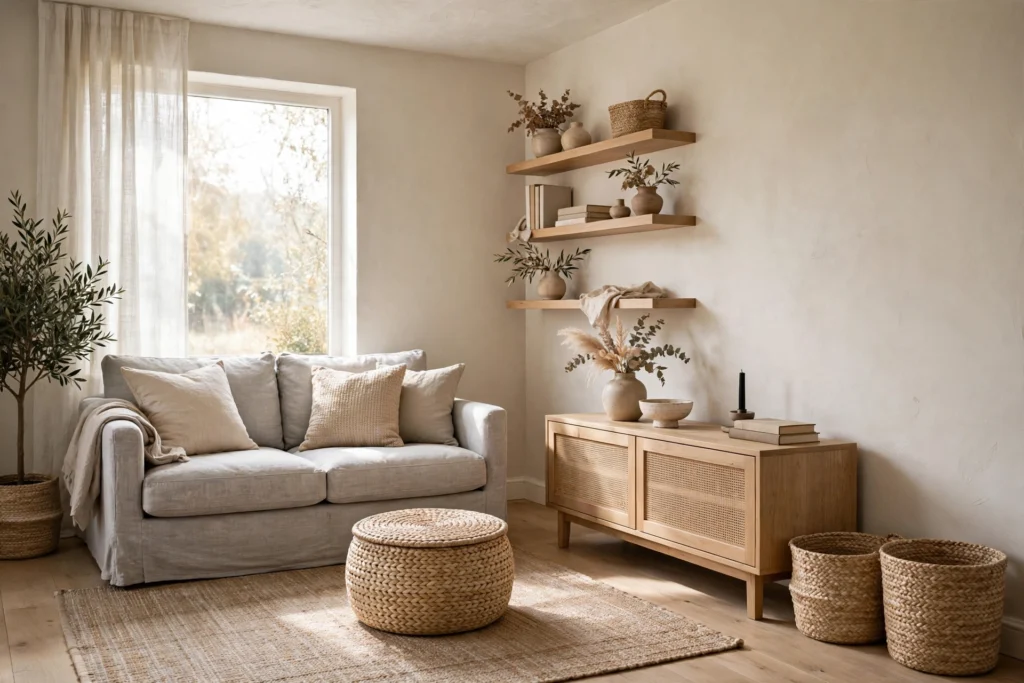
- Furniture that hides storage (#1–#7)
- Walls & vertical space (#8–#13)
- Zones & daily systems (#14–#18)
- Small-space layout tricks (#19–#21)
- Small living room checklist
Furniture That Hides Storage
1. Storage Ottoman Instead of a Coffee Table
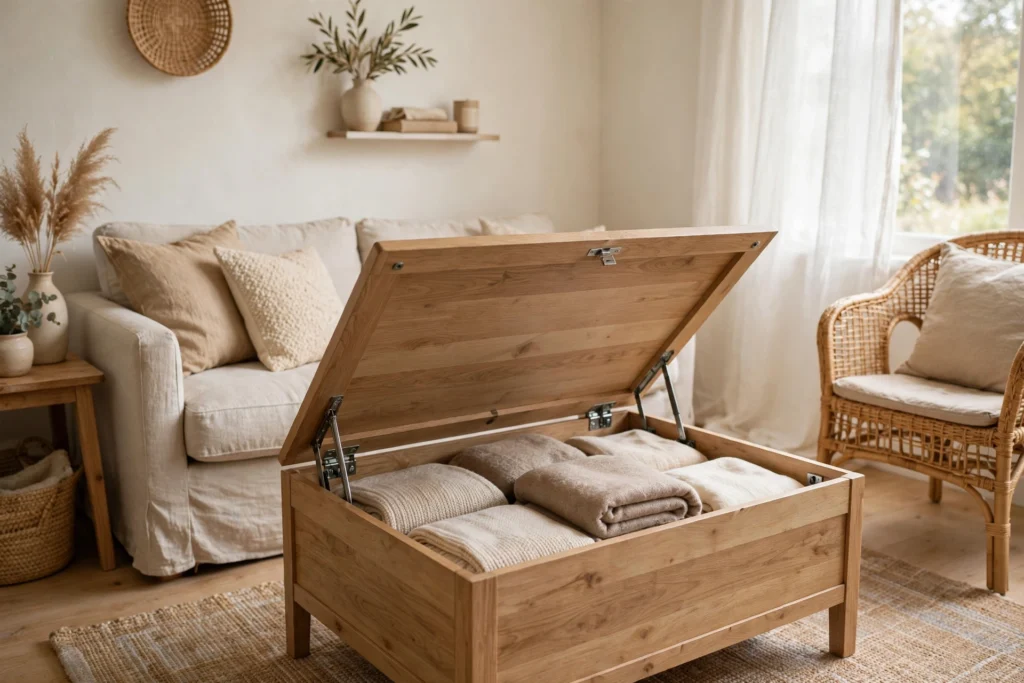
A large storage ottoman (around 30 x 30 inches, $60–$120) replaces the coffee table and swallows throw blankets, board games, and the TV remotes. Top it with a tray and it still holds drinks. In rooms under 150 square feet, this one swap can eliminate three separate clutter piles. Get one with a lift-off lid rather than hinged — hinged lids slam and pinch fingers.
2. Lift-Top Storage Coffee Table
If you can’t part with a real table, get a lift-top version ($80–$150). The top raises to laptop height for working from the couch, and the hidden compartment underneath holds chargers, notebooks, and remotes. It’s the hardest-working piece of furniture you can put in a small living room, and it looks completely normal doing it.
3. Sofa with Built-In Storage
Storage sofas hide compartments in the chaise or under the seat cushions — perfect for spare bedding, seasonal throws, and kids’ toys. They cost $100–$200 more than standard sofas, but that’s cheaper than buying a separate storage unit plus the floor space it would eat. If you’re sofa shopping anyway, this is the upgrade to make.
4. Nesting Side Tables
Two nesting tables ($40–$70 for the pair) give you surface space when guests come and tuck into one footprint daily. Use the smaller one as a plant stand in the corner when nested. It’s the small-space answer to “we never have enough table space” without permanently sacrificing floor area.
5. Media Console with Closed Doors
Open media shelves become clutter display cases within a week. A console with doors ($90–$160 for a 50-inch unit) hides the router, game controllers, DVDs, and cable tangle. Drill one small hole in the back panel for cords if needed. Out of sight really does mean out of mind — and out of the dusting rotation.
6. Lidded Baskets as Decor
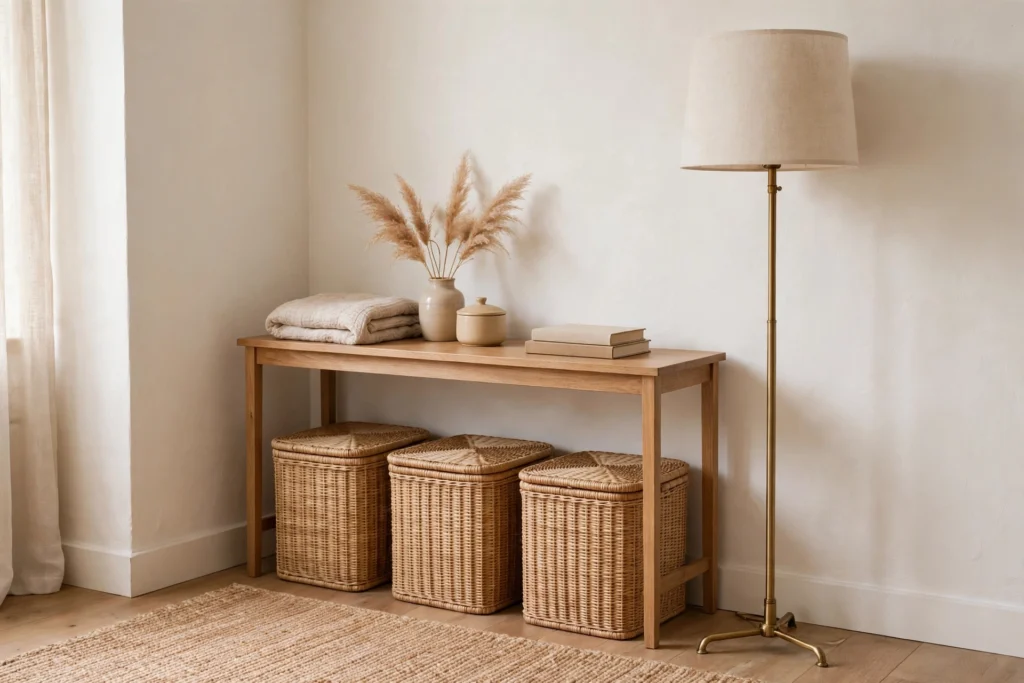
Two or three large lidded baskets ($15–$25 each) beside the sofa or under a console table hold the stuff that defies categories: extra pillows, the dog’s toys, craft supplies. Lids are non-negotiable — open baskets in living rooms become junk magnets within days. Seagrass or woven textures double as decor.
7. Under-Sofa Storage Boxes
The 4–6 inch gap under most sofas fits flat rolling boxes ($10–$15 each) perfectly. Store wrapping paper, board games, or off-season decor there. Measure your clearance first — low-profile modern sofas sometimes have zero gap, in which case skip this and use the space behind the sofa instead.
Walls & Vertical Space
8. Floating Shelves Instead of Bookcases
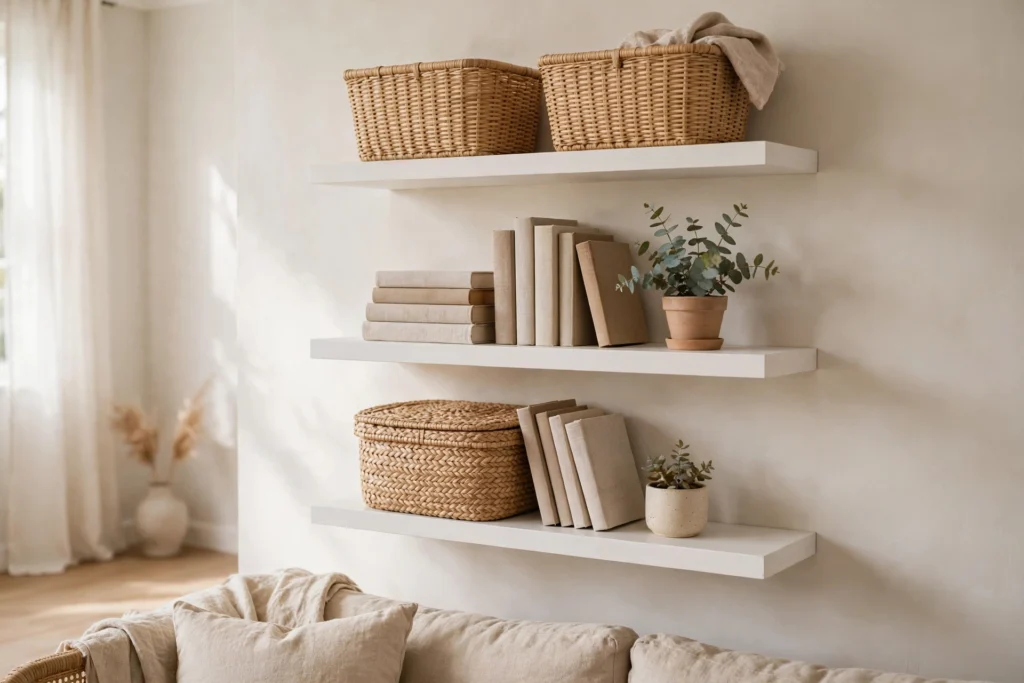
A pair of 36-inch floating shelves ($20–$35 each with brackets) holds what a whole bookcase does without eating 12 inches of floor depth. Style them with a mix: books horizontal and vertical, one basket for small items, one plant. Keep 30% of each shelf empty — crammed shelves read as clutter no matter how organized they are.
9. Over-Door Organizers (for Closets Nearby)
If your living room has a coat or hallway closet, a $10 over-door organizer with clear pockets handles batteries, tape, scissors, pet supplies, and all the small things that otherwise colonize the coffee table. Clear pockets matter — you’ll actually use what you can see.
10. Picture Ledges for Books & Art
Narrow picture ledges ($12–$20 each) display kids’ books facing out (kids choose books by covers, not spines) and rotate seasonal art without nail holes everywhere. Two ledges stacked 12 inches apart on one wall create a whole reading nook’s worth of storage in 4 inches of depth.
11. Wall-Mounted Magazine/Mail Holder
A wall-mounted file holder ($10–$18) by the entry side of the living room catches mail, school papers, and takeout menus before they hit the table. Sort it weekly — Sunday reset works great — or it becomes wall-mounted clutter instead of table clutter. Same mess, different surface; the system only works if you maintain it.
12. Hooks for Throws & Bags
Three sturdy wall hooks ($3–$5 each) by the door or behind it hold the everyday tote, the dog leash, and the throw blanket that’s always on the couch. Hooks use zero floor space and end the “drape it on the chair” habit. Mount into studs — adhesive hooks give up right when the bag is heaviest.
13. Tall Narrow Bookcase in Dead Corners
That awkward 18-inch gap beside the window? A tall narrow bookcase ($40–$70) turns dead space into 5 shelves of storage. Go tall and narrow rather than short and wide in small rooms — vertical storage draws the eye up and makes ceilings feel higher. Anchor it to the wall; tall furniture in small rooms must be stable.
Zones & Daily Systems
14. The 5-Minute Nightly Reset
Set a phone alarm for 5 minutes before bed. Everyone in the house returns 10 things to their homes — cushions fluffed, throws folded, remotes in the tray, toys in the basket. A living room that’s reset nightly never reaches disaster level. This single habit does more than any furniture purchase on this list.
15. One-In-One-Out for Decor
Small rooms can’t absorb new decor without shedding old. New throw pillow in? An old one goes to the donation bag. New candle? Finish or gift an old one first. This rule sounds strict until you realize it’s the only thing standing between “curated” and “knick-knack explosion” in under 200 square feet.
16. The Catch-All Tray
Every living room needs one beautiful tray ($12–$20) on the coffee table or ottoman. Remotes, coasters, lip balm, the pen you were looking for — they all live in the tray. Without it, these micro-items scatter across every surface. With it, “cleaning” the table means moving one tray. This is the highest ROI $15 in home organization.
17. Toy Rotation Basket
Keep one medium basket of toys in the living room — just one. The rest live in the bedroom closet, and you swap the basket’s contents every Sunday. Kids play more deeply with fewer choices, cleanup takes 3 minutes, and your living room never looks like a daycare. Because it takes so little effort to keep up, it’s one of the easiest systems for families to stick with.
18. Charging Station in a Drawer or Box
Phones, tablets, earbuds, and their cables multiply on side tables. A $15 charging station box (or a drawer fitted with a $10 USB hub) corrals them all in one spot. No more cable spaghetti across the side table, no more “where’s my charger” mornings. Put it where you naturally sit in the evening so devices actually end up there.
Small-Space Layout Tricks
19. Float the Sofa (Even 6 Inches)
Pushing the sofa 6 inches off the wall creates breathing room that tricks the eye into seeing more space — and gives you a slim gap behind it for a narrow console or nothing at all. In tiny rooms the instinct is to shove everything against walls, but a little air around furniture actually makes rooms feel larger, not smaller.
20. One Large Rug Instead of Small Ones
A rug that fits under the front legs of all seating (8×10 in most small living rooms, $80–$150) unifies the space; small floating rugs chop it into visual fragments that feel cramped. This is the most common mistake I see. One big rug = one cohesive room. Measure first — too-small rugs are worse than no rug.
21. Mirrors Opposite Windows
A large mirror ($30–$60 at discount stores) hung opposite the main window doubles the natural light and visually doubles the room. Lean a floor mirror in a dead corner if you can’t hang one. It’s the oldest small-space trick because it genuinely works — light and reflection do what square footage can’t.
Small Living Room Organization Ideas: Quick Checklist
Run through this once and your living room will feel twice as big:
Furniture
- ☐ Coffee table or ottoman has hidden storage
- ☐ Media items behind closed doors
- ☐ 2–3 lidded baskets for overflow categories
- ☐ Under-sofa space measured and used (or ruled out)
Walls
- ☐ Floating shelves installed (30% empty)
- ☐ Hooks mounted for bags/throws
- ☐ Dead corner evaluated for tall narrow storage
Systems
- ☐ Catch-all tray on the main table
- ☐ Charging station set up
- ☐ Nightly 5-minute reset on the calendar
- ☐ One-in-one-out rule agreed with the household
Layout
- ☐ Sofa floated slightly off the wall
- ☐ Rug sized to front legs of seating
- ☐ Mirror placed opposite the main window
How to Organize a Small Living Room in 5 Steps
Ideas are easier to use with an order to follow. This is how to organize a small living room in one afternoon, about 2 to 3 hours from start to finish.
- Clear the surfaces (30 minutes). Coffee table, side tables, console and shelves go into one laundry basket. Anything that belongs in another room goes back there now.
- Edit by category (45 minutes). Sort the basket into piles of remotes and chargers, books and magazines, throws and pillows, toys, and decor. Keep what you use weekly or truly love, and donate the rest. A good limit is 3 to 5 decor pieces per surface.
- Measure before you buy (15 minutes). Measure the wall behind the sofa, the space under the TV and the dead corners. Write the numbers on your phone so every basket or shelf you buy actually fits.
- Give each category one closed home (45 minutes). Remotes go in a lidded box, throws in a basket or ottoman, kids’ toys in one bin, and cords and chargers in a drawer. Closed storage hides the visual noise that makes a small room feel crowded.
- Set the reset (15 minutes). Put a catch-all tray where keys and mail land, then do a 5-minute pickup before bed. Most nights it takes under 3 minutes once everything has a home.
Finish with a quick clean while the room is empty. The no-bending baseboard method takes about 15 minutes, and the room by room cleaning checklist keeps the living room on a weekly rhythm.
Small Living Room Ideas With a TV: Hide the Mess
In a small living room, the TV wall is usually the most cluttered spot: a tangle of cords, consoles, remotes and game controllers. These fixes keep it calm.
- Mount the TV and add a closed console below. A wall-mounted TV frees up the console top. Pick a console a few inches wider than the TV, with doors or drawers, so devices and games sit out of sight.
- Hang it at seated eye level. Aim for the center of the screen at about 42 inches from the floor for a standard sofa, not above a tall dresser or fireplace, which strains your neck in a small room.
- Hide every cord. A paintable cord raceway running from the TV to the outlet hides cables on a rental-friendly wall. Stick the streaming box to the back of the TV or console with mounting strips.
- One home for remotes and controllers. A small lidded box on the coffee table or a drawer in the console. If remotes have a home, they stop disappearing into the sofa.
- Try the corner. In a narrow room, a corner TV on a swivel mount or a corner console opens up the long wall for seating and frees the walkway.
Living in a studio or one-bedroom where the living room does three jobs? See how to organize a small apartment for zoning tricks, and these cozy living room storage ideas for more pieces that hide clutter in style. Short on closet space for spare throws in summer? Use the vacuum-bag method in how to store winter clothes in a small space.
Grab the Free Printables
A calm living room needs a calm routine behind it — download our free Weekly Reset Planner and Room-by-Room Cleaning Checklist. The Sunday reset section is what keeps all 21 of these ideas working week after week.
Keep Reading
Save this for later
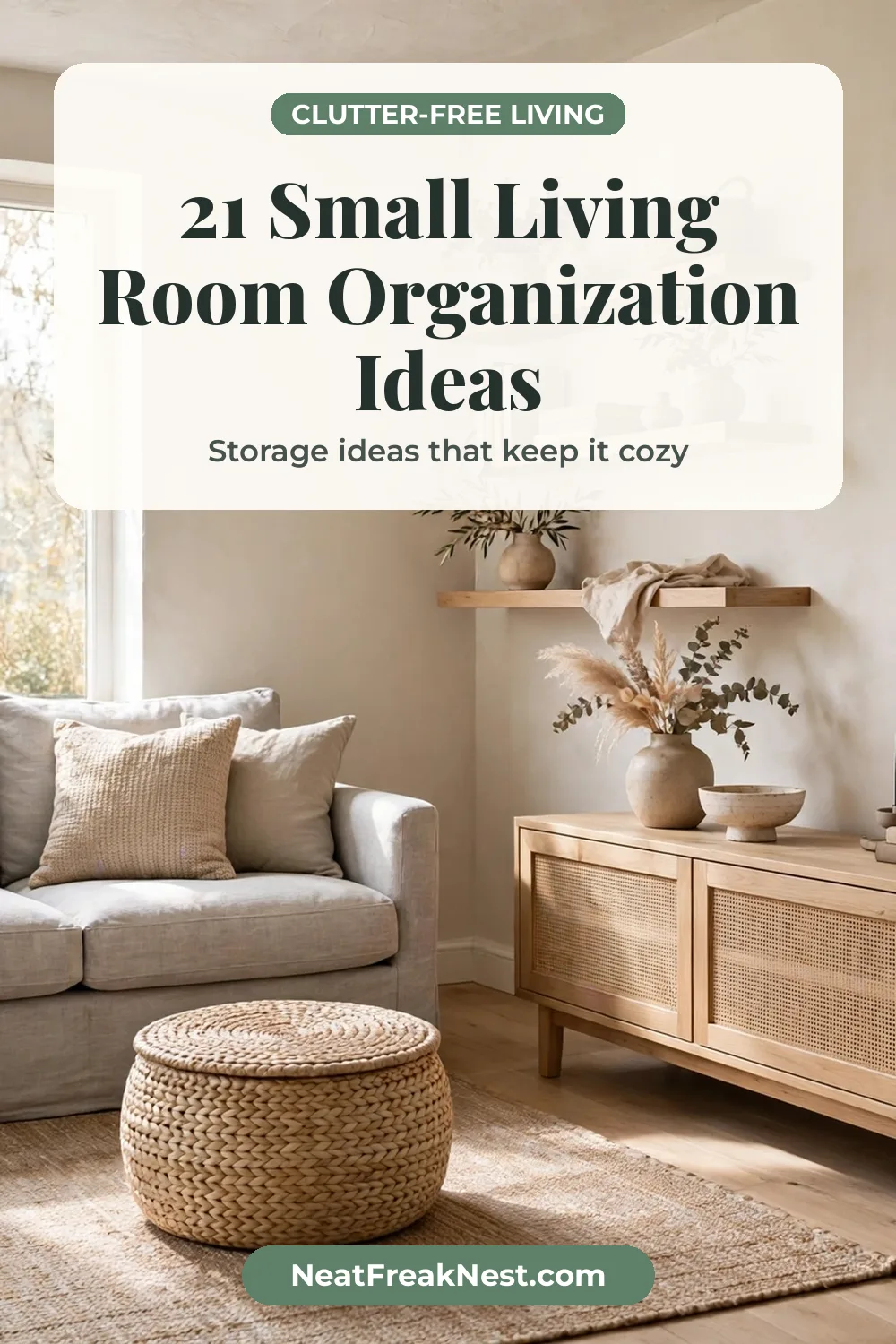
Pin this image to your Pinterest board so it’s there when you need it.
 Save to Pinterest
Frequently Asked Questions
How do I organize a small living room with no storage?
Add storage that looks like furniture: a storage ottoman or lift-top coffee table, a closed media console, lidded baskets under side tables and floating shelves on empty wall space. Then cut down what lives there, because no amount of storage fixes a room with too much stuff.
How do I make a small living room look bigger?
Clear the floor and the surfaces, use closed storage instead of open shelving for everyday clutter, pick one large rug instead of several small ones, float the sofa a few inches off the wall and hang a mirror opposite a window to bounce light around.
Where should I put things in a small living room?
Give each category one home close to where it is used: remotes in a lidded box on the coffee table, throws in a basket by the sofa, chargers in a console drawer and toys in one bin you can slide out of sight. Anything without a daily use belongs in another room.
How do I hide clutter in a small living room?
Use closed storage for anything with lots of small parts, like cords, games, toys and paperwork, and keep open shelves for a few books and decor pieces. A catch-all tray for keys and mail plus a 5-minute nightly reset stops clutter from building up again.
Pingback: 12 Entryway Organization Ideas for a Clutter-Free First Impression
Pingback: 21 Toy Organization Ideas for Small Spaces That Stay Tidy