
To organize a junk drawer, empty it completely, keep only the things you reach for at least once a month, and give each category its own divider section, usually six to eight small zones in a typical 12- to 18-inch kitchen drawer. The whole job takes about 15 minutes and under $20 in trays, and the 19 junk drawer organization ideas below show layouts that stay tidy.
⏱️ Short on time?
Grab our FREE printable checklists — the exact routines behind every calm home on this blog:
📋 Room-by-Room Checklist (PDF)📅 Weekly Reset Checklist (PDF)
Part of our Decluttering & Small Space Organizing Guide, which brings every related post together in one place.

Why Every Junk Drawer Explodes (and Why That’s Normal)
A junk drawer isn’t a failure — it’s a symptom of a missing system. Small everyday items need a landing spot, and without assigned zones, the kitchen’s most-used drawer becomes the default dumping ground for the whole house. The fix isn’t willpower; it’s structure. Once each category has a defined section, putting things back takes two seconds, and the drawer stops being a black hole.
The second reason drawers explode: they hold things that don’t belong in them at all. Office supplies migrate to the kitchen, tools wander in from the garage, expired coupons quietly multiply. Part of this project is eviction — the reset below clears the decks before a single organizer goes in.
The 15-Minute Reset: Do This Before You Buy Anything
Don’t buy organizers yet. Organizers bought for a drawer you haven’t sorted always end up the wrong size. Do this first:
- Dump everything onto the counter and wipe the drawer clean. Crumbs and sticky residue make even good systems feel gross.
- Test as you sort. Click every pen. Check every battery with a tester or toss the loose ones into a bag for the next battery-recycling drop. This one step usually removes a third of the volume.
- Make four piles: stays in this drawer, belongs in another room, trash/recycling, and “mystery” (keys and parts you can’t identify — give them a labeled envelope, not drawer real estate).
- Relocate the wanderers now — walk the “other room” pile to its homes before you continue. If you skip this, it all slides back in.
- Group what stays into categories — writing tools, tech/chargers, batteries, small tools, fasteners, paper goods. You’ll see exactly how many zones you need.
Now you know your drawer’s real inventory. If this reset scratched an itch, our 10-minute decluttering tasks are built for exactly this kind of quick win.
19 Junk Drawer Organization Ideas That Actually Hold Up
Build the Right Base First
1. Measure the drawer before you shop. Write down the inside length, width, and depth on your phone. Organizer trays that “look about right” at the store are wrong often enough that this 30-second step pays for itself. Depth matters most — a tray that’s half an inch too tall keeps the drawer from closing.
2. Line it with a washable liner. A cut-to-fit drawer liner (about $6 for a roll) keeps small items from sliding, muffles the rattle, and wipes clean when a pen leaks. Get the non-adhesive kind so you can lift it out and shake off crumbs.
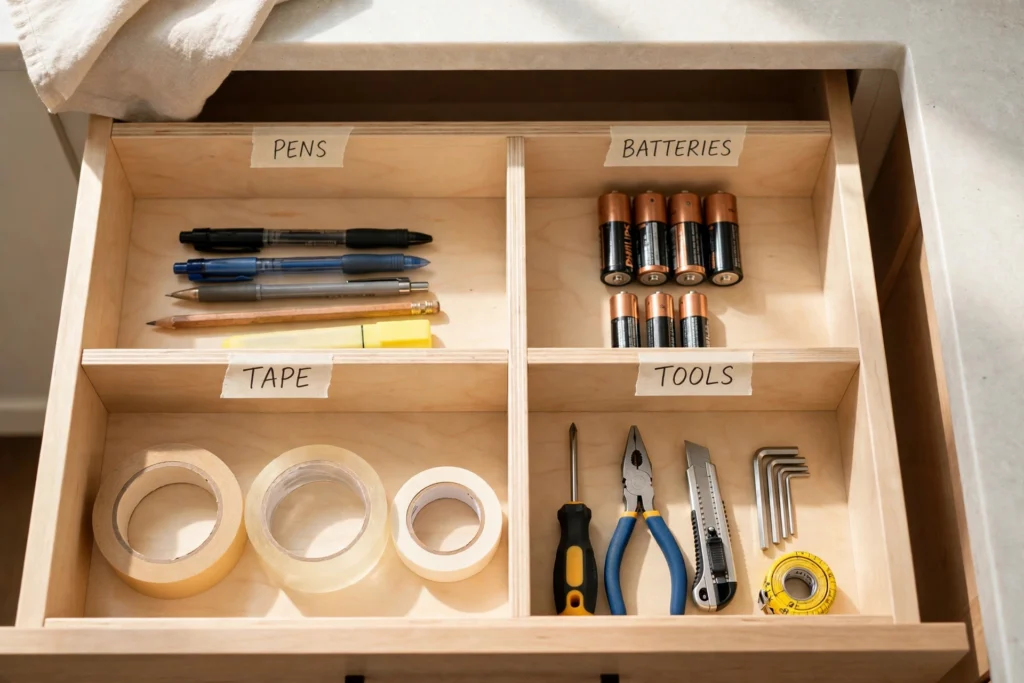
3. Start with one expandable tray, not five small ones. A single bamboo or plastic expandable organizer ($10–$15) covers most standard drawers and adjusts if you rearrange. It’s the backbone of the whole system — every idea below plugs into zones this tray creates.
Give Every Category a Zone
4. Corral all writing tools in one long, narrow section. Pens, pencils, Sharpies, and highlighters go together — only the ones that work. Stash the extras (that 12-pack from the office supply sale) somewhere else entirely.
5. Create a tech corner for chargers and earbuds. Spare charging cables, earbuds, and old phone chargers tangle into a nest within days. A small lidded box or a cable organizer keeps them separate and untangled. Label which cable fits which device with a strip of masking tape — future-you will be grateful.
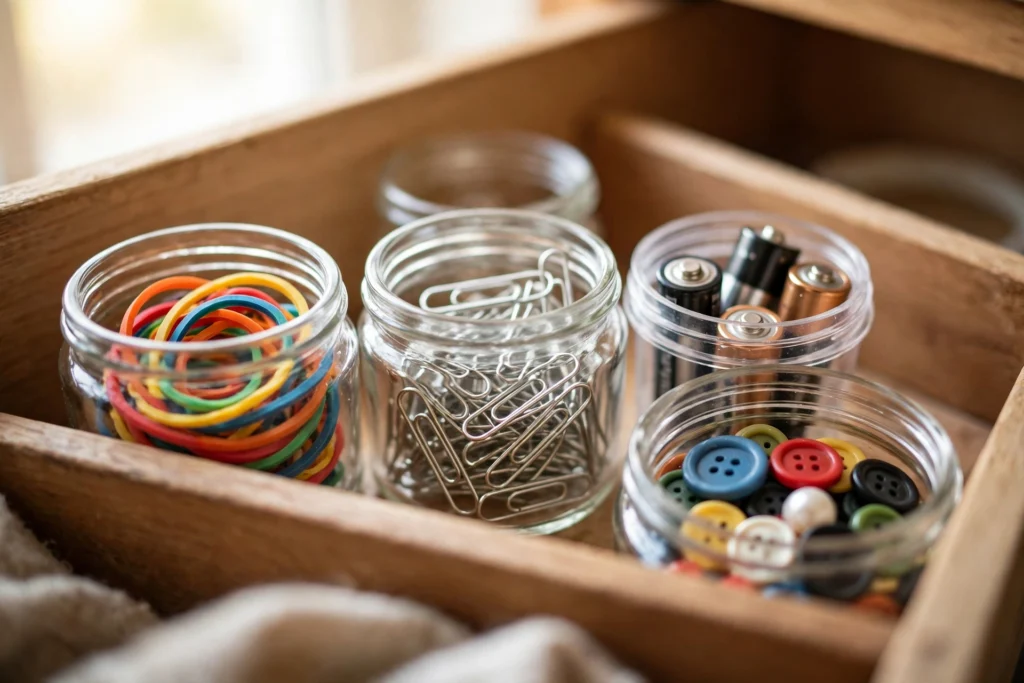
6. Store batteries in their original packaging inside one small container. Loose batteries rolling around with keys or coins can short, which is a genuine fire risk. Keep them in the packaging they came in, standing upright in a small box — and route dead ones to a battery-recycling drop instead of back into the drawer.
7. Give small tools their own narrow slot. The tape measure, small screwdriver, box cutter, and mini level you grab weekly deserve a home — the full toolbox can stay in the garage. One narrow divider section keeps them findable without turning the drawer into a hardware store.
8. Contain fasteners in tiny jars or tins. Rubber bands, paper clips, binder clips, twist ties, and safety pins vanish into drawer corners. Small clear jars, old mint tins, or condiment cups keep each type visible and scoopable. Clear beats cute here — if you can’t see it, you’ll buy another pack.
9. Tame paper with an envelope system. Takeout menus, coupons, stamps, gift cards, and receipts get one slim envelope or folder standing upright at the back of the drawer. Once a month, pull it out and toss anything expired. Paper is the number-one drawer filler because it arrives daily and never announces itself.
Small Containers, Big Difference
10. Raid your recycling before you buy organizers. Small boxes, glass yogurt jars, and sturdy takeout containers work beautifully as drawer compartments. Cut cardboard boxes to height for free custom dividers. If the recycled version works for a month, then consider buying the “real” one.
11. Use an ice cube tray for the tiniest items. Buttons, thumbtacks, earring backs, spare screws, and SIM tools fit perfectly in ice cube tray compartments. It’s the cheapest micro-organizer in existence (about $1 at the dollar store) and it keeps small hardware from migrating under everything else.
12. Add a shallow top tray for daily grab-and-go items. A slim tray across the top of the drawer holds the 4–5 things you reach for daily — lip balm, the pen you actually use, a hair tie, mints. Everything else lives below. This two-layer setup is what makes the drawer feel organized even on busy mornings.
13. Stick a magnetic strip inside for metal bits. A small adhesive magnetic strip ($4–$6) along the drawer’s back wall holds nail clippers, tweezers, small scissors, and spare keys upright and visible. It uses dead vertical space and stops metal tools from scratching everything else.
Keep It That Way With 60-Second Habits
14. Enforce the “touch it once” rule. When you open the drawer, the item goes back to its zone — not “near” its zone, not “on top for now.” This single habit is the difference between drawers that stay organized and drawers that relapse.
15. Label the zones for the first month. Small strips of masking tape with “pens,” “batteries,” “tape” written in marker look humble and work perfectly. Labels do two jobs: they remind you where things go, and they stop other household members from inventing their own system. Peel them off once the zones are second nature.
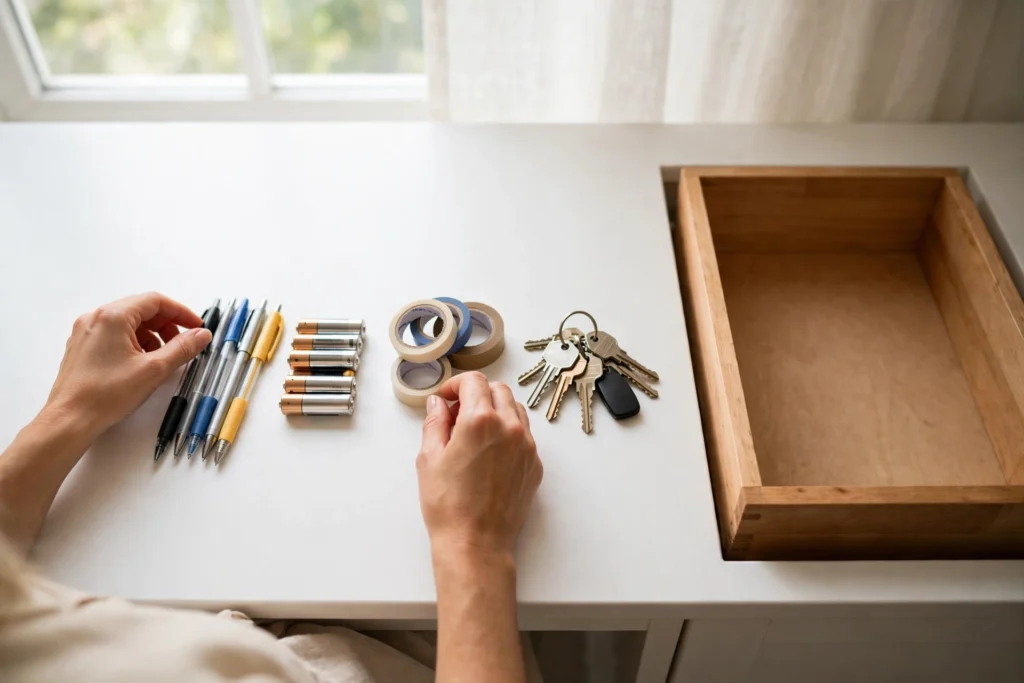
16. Run a two-minute weekly reset. Once a week — Sunday night works — pull out anything that wandered in, test the pens, and toss the expired coupons. Two minutes, standing at the counter. Pair it with your 30-day decluttering checklist routine and it becomes automatic.
17. Keep a “relocation basket” nearby, not in the drawer. A small basket on the counter catches items that belong elsewhere — the screwdriver that lives in the garage, the office scissors, the kid’s toy. Empty it when it’s full. Without this, wanderers go straight back into the drawer “temporarily.”
Two Upgrades Worth the Money
18. Try a spring-loaded drawer divider set. If your drawer is wider than standard trays, spring-loaded dividers ($12–$18 for four) press against the drawer walls and create custom compartments that don’t slide. They’re the best fix for deep or oddly sized drawers where trays swim around.
19. Add a motion-sensor light. A $8 stick-on motion light inside a deep drawer sounds like overkill until you use one. Deep drawers are dark drawers, and dark drawers hide the dead batteries and expired coupons that restart the chaos. Light makes the weekly reset almost fun.
What Doesn’t Belong in the Junk Drawer
Be honest about these common squatters — each one has a better home:
- Important documents (passports, titles, warranties) → a filing box or fireproof bag, never a kitchen drawer.
- Medications and vitamins → a dedicated cabinet away from heat and kid-reach; the kitchen drawer fails both tests.
- The full tool collection → keep only the 3–4 weekly-use tools here; the rest belongs in a toolbox.
- Office supplies in bulk → one pen and a notepad here; the 12-pack lives at the desk.
- Spare keys you can’t identify → labeled envelope, and if a key stays unidentified for six months, it’s safe to let it go.
Evicting these five categories often frees up half the drawer — which is exactly how a “junk drawer” quietly becomes a genuinely useful utility drawer. (The same eviction logic works wonders under the sink, the other spot where mystery items go to hide.)
What Actually Works (and Common Mistakes)
The specifics that make the difference, with safety points checked against the public sources listed below.
- Measure before you buy. Note the inside width, depth and height of the drawer, then leave about 1/4 inch of play so trays lift out without jamming. Check the height too: tall trays can catch on the cabinet frame when the drawer closes.
- Line the bottom first. A cut-to-size non-slip liner keeps trays from sliding forward every time the drawer is yanked open.
- Give batteries their own lidded box. Keep them in the original packaging or a small case, never loose with keys and paper clips. EPA advises taping the terminals of lithium batteries (or bagging them separately) to prevent fires, and the same habit keeps a loose 9-volt from shorting against metal.
- Keep coin and button cells up high. They are easy for small children to swallow, so they belong in a closed container out of reach, not in a low open tray.
- Add a two-minute weekly reset. Anything that wandered in (receipts, hair ties, a stray screw) goes back where it lives. Drift, not one bad day, is what refills a junk drawer.
Common mistakes
- Buying organizers before sorting, so the trays end up the wrong size for what you actually keep.
- Keeping expired coupons, dead pens and takeout menus just in case.
- Storing uncapped blades, box cutters or loose screws where hands rummage blindly.
Sources & safety notes: EPA: Used Household Batteries · EPA: Household Hazardous Waste. Safety points were checked against these pages on November 1, 2026. Spot something wrong? Tell us and we will correct it.
Related guides
Save this for later
Pin this image to your Pinterest board so it’s there when you need it.
 Save to Pinterest
Junk Drawer FAQ
What should actually go in a junk drawer?
Everyday small items you reach for weekly: working pens, scissors, tape, batteries in packaging, a few small tools, chargers, rubber bands, and paper goods like stamps and coupons. If you haven’t touched it in three months, it doesn’t earn drawer space.
How do I keep my junk drawer from getting messy again?
Three things: assigned zones with labels for the first month, the touch-it-once rule when putting items back, and a two-minute weekly reset to evict wanderers. Systems fail from drift, not from one bad day — the weekly reset catches drift early.
What’s the cheapest way to organize a junk drawer?
Under $5: a dollar-store ice cube tray for small items, cut-down cardboard boxes as dividers, and masking-tape labels. The sorting itself is free and does most of the work.
Should I just get rid of my junk drawer entirely?
Only if every item in it already has a better home, which is rarely true in a real house. A well-zoned junk drawer beats no catch-all at all — the goal is a controlled utility drawer, not an empty one.
Keep the Whole House This Tidy
A calm junk drawer is a great start — now put the same 15-minute system to work everywhere else. Grab our free decluttering and cleaning checklists and work through one small space at a time. Fifteen minutes a drawer, and the whole house starts feeling lighter.
Pingback: 17 Kitchen Countertop Organization Ideas