
To organize a nightstand, keep only three to five things on top (lamp, water, one book, phone charger), move the rest into a drawer with small dividers, and route cords behind the furniture with a clip or short cable box. These nightstand organization ideas cover the surface, the drawers and the cords, and a two-minute reset each night keeps it that way.
⏱️ Short on time?
Grab our FREE printable checklists — the exact routines behind every calm home on this blog:
📋 Room-by-Room Checklist (PDF)📅 Weekly Reset Checklist (PDF)
Part of our Living Room, Bedroom & Holiday Storage Guide, which brings every related post together in one place.
The good news: a nightstand is the smallest organizing project in your whole house. It has one surface, one or two drawers, and a very short list of things that genuinely belong there. These 21 nightstand organization ideas fix it zone by zone — the surface, the drawers, the cords, and even the “I don’t have a nightstand” problem — most of them in under 15 minutes.
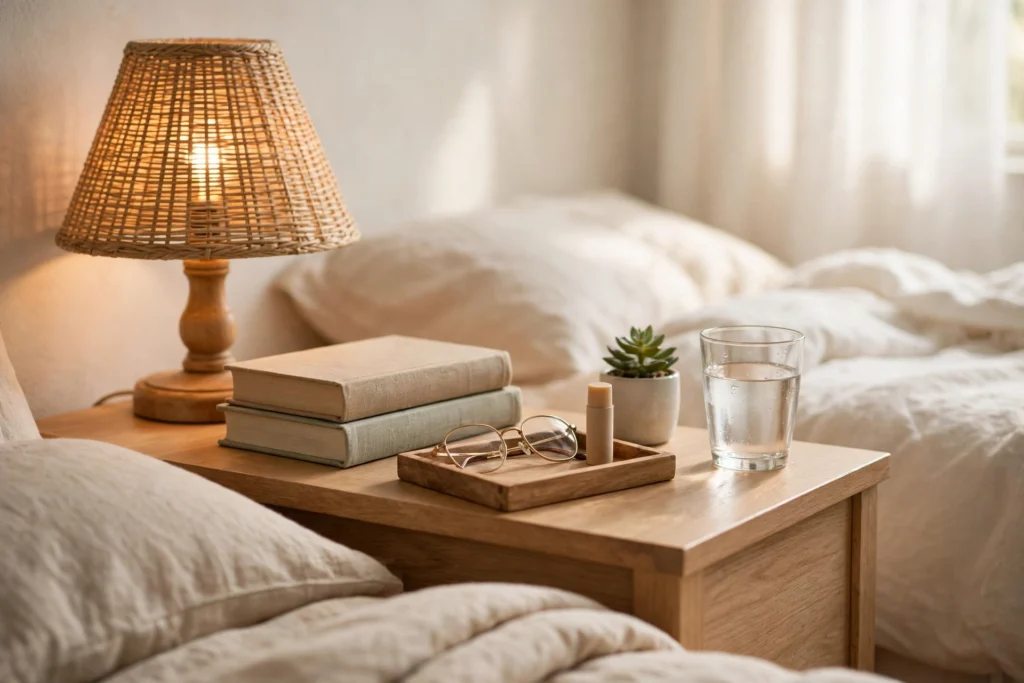
Zone 1: The Surface — Less, But Better
1. Follow the rule of three on top
A calm nightstand surface holds about three things: a lamp, one personal item (a photo, a small plant, a candle), and the book you’re actually reading. Everything else has to earn its place or live somewhere else. When in doubt, remove one thing and see if you miss it — you won’t.
2. Corral the small stuff on a tray
A small tray or shallow dish is the single best nightstand upgrade. Glasses, lip balm, your watch, and the water glass all land on the tray, and somehow a tray full of stuff looks tidy while the same stuff scattered looks like a mess. It also makes dusting a 10-second job: lift the tray, wipe, done.
3. Give your water glass a home base
Commit to one glass or carafe on a coaster — not a rotating collection of cups migrating from the kitchen. One glass, washed when you do the morning dishes. If you love a nighttime drink, a lidded carafe-and-cup set keeps dust out and looks intentional.
4. Shrink the lamp, grow the surface
A bulky table lamp can eat half your nightstand. Swap it for a wall-mounted sconce, a clip-on reading light, or a slim lamp with a small footprint. You’ll reclaim enough room for the tray and your book without anything teetering on the edge.
5. Keep one book, not a library
Reading piles grow because there’s no limit. Set one: the current book lives on the nightstand, the next-up book can join it, and everything else goes back to a shelf or your under-bed storage book bin. Finished a book? It leaves the same day.
Zone 2: The Drawers — Where the Real Mess Hides
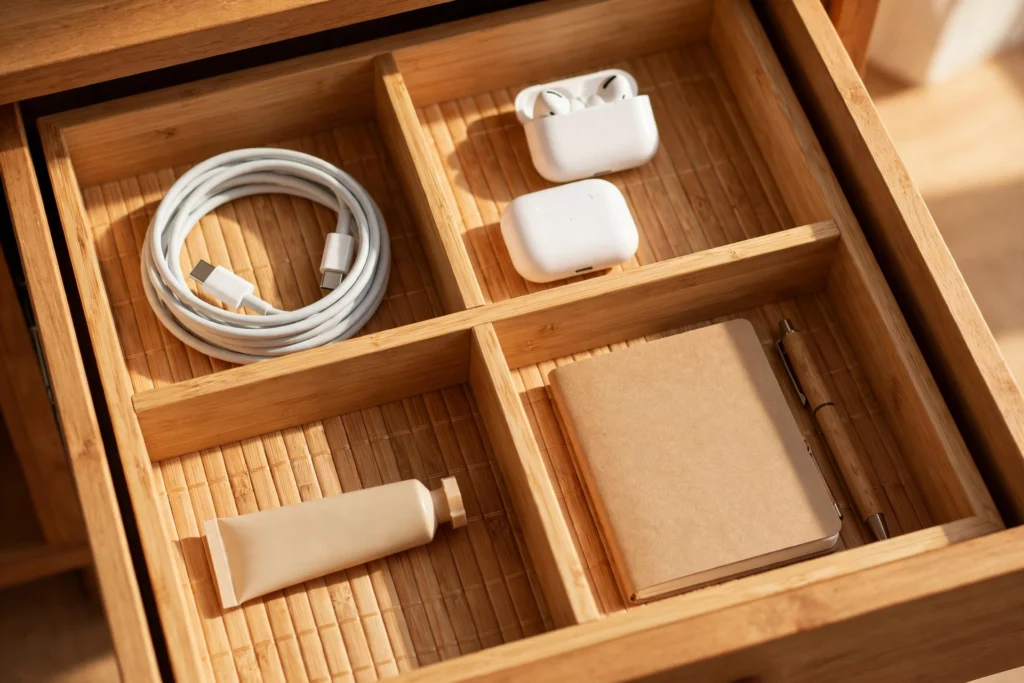
6. Divide the top drawer
An undivided nightstand drawer becomes a junk drawer with better PR. Add bamboo dividers or a few small trays so chargers, earbuds, hand cream, and meds each get a compartment. Drawer organizer sets run $10–15 and take two minutes to drop in — no measuring marathons required if you buy adjustable ones.
7. Reserve the top drawer for nightly essentials only
The top drawer has one job: the things you reach for between getting into bed and falling asleep. Reading glasses, lip balm, hand cream, your journal, meds you take at night. If you haven’t touched it in a week of bedtimes, it doesn’t belong in the prime drawer.
8. Corral tiny things in small containers
Lip balms, hair ties, nail clippers, and spare buttons roll around and multiply in the dark. Give them one small jar, tin, or lidded box inside the drawer. Contained, they’re a system; loose, they’re clutter confetti.
9. Move bulk and backups out
The economy-size lotion refill, the spare phone cables, the extra tissue box — backups belong in a closet or bathroom cabinet, not your nightstand. Keep only the in-use item at the bedside and restock from your storage spot like a tiny hotel.
10. Use lower drawers for low-frequency storage
Second and third drawers are perfect for things you need near the bedroom but not nightly: seasonal items (a fan remote in winter, extra blanket in summer), gift wrap for last-minute presents, or the book series you’re working through. Label the drawer edge if you share the room — it stops the “where is the…?” at 11 pm.
Zone 3: Cords and Charging — End the Cable Nest
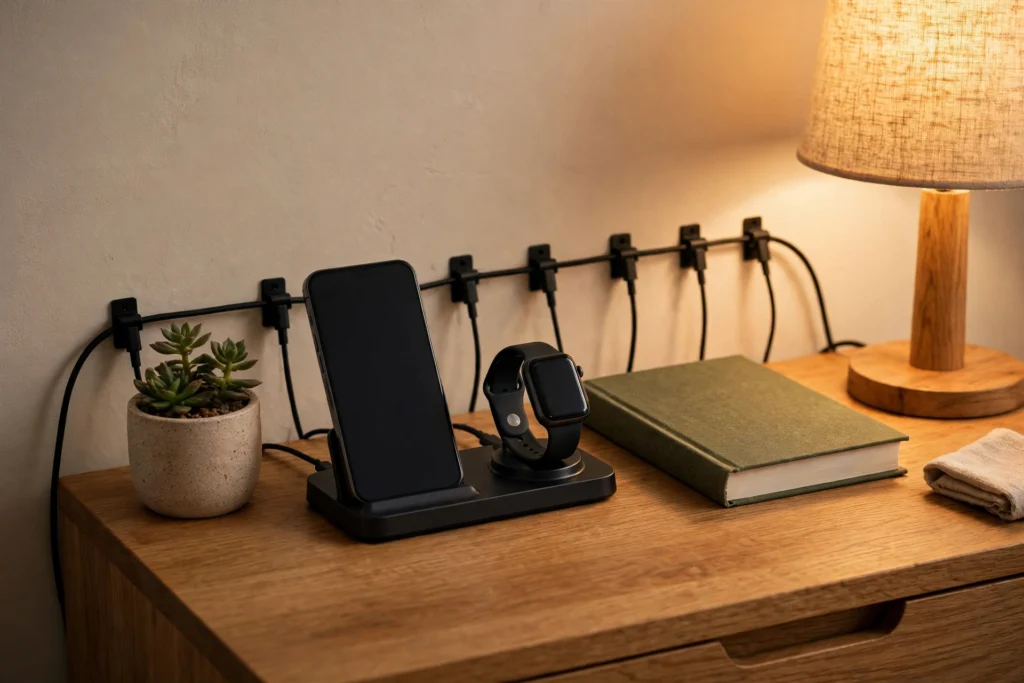
11. Build one charging station
Phone, watch, earbuds, e-reader — give them all one dock or one corner of the nightstand. A compact multi-device charging stand ($15–25) replaces three separate bricks and cables with one plug, and a charged-everything morning routine becomes automatic.
12. Route cords behind, not across
Run cables down the back of the nightstand with adhesive cord clips, and plug everything into one power strip tucked behind or under the bed. Cords you can’t see can’t annoy you — and they stop collecting dust bunnies on the floor where you step in the dark.
13. Try an in-drawer charging setup
If surface space is precious, charge inside the top drawer: run one cable through the back of the drawer (many nightstands have a gap, or drill one small hole in the back panel — never the front). Phone sleeps in the drawer, surface stays clear, and the screen is out of sight while you wind down.
Zone 4: No Nightstand? No Problem
14. Hang a bedside caddy
A fabric bedside caddy tucks under the mattress and holds a book, phone, glasses, and remote in flat pockets. It costs under $15, needs zero floor space, and is the classic dorm solution that works just as well in grown-up small bedrooms.
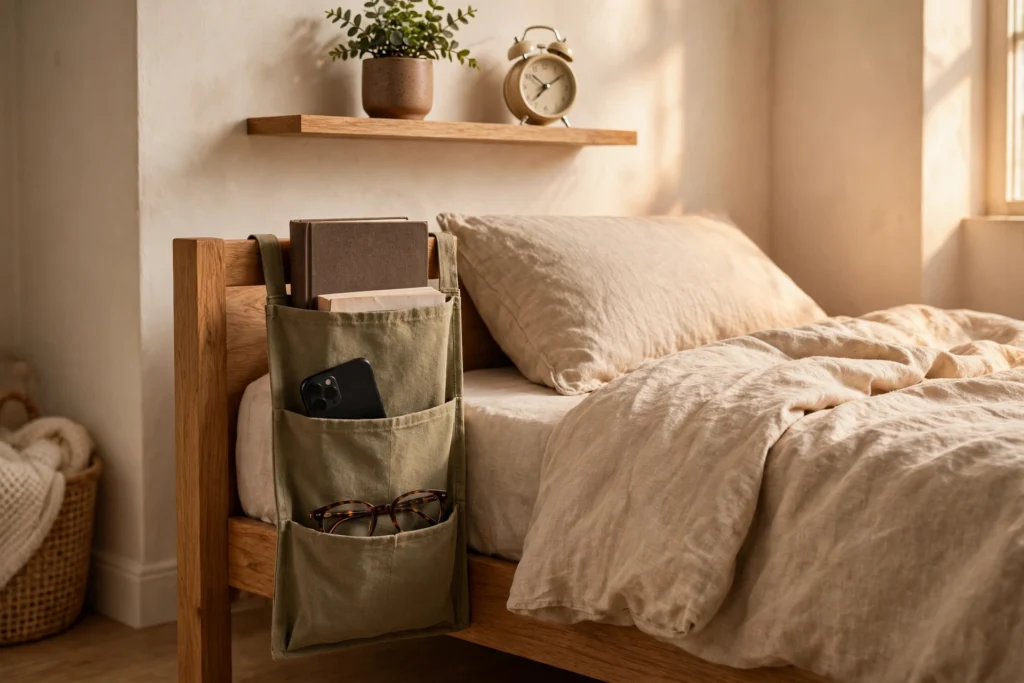
15. Float a small shelf
A 12–16 inch floating shelf at mattress height does everything a nightstand does: lamp (clip-on), book, water, phone. It’s the best fix for rooms where the bed is wedged wall-to-wall, and it’s a core move in any small bedroom organization plan.
16. Press a rolling cart into service
The slim 3-tier rolling cart you already love for laundry and bathrooms makes a great mobile nightstand: top tier for lamp and book, middle for chargers, bottom for extras. Roll it away when you vacuum or have guests — try doing that with a solid oak nightstand.
17. Use a stool, chair, or stack of crates
A sturdy stool or a simple chair beside the bed holds the essentials and reads as intentional styling, especially with a tray on top. Wooden crates stacked two high even give you a “drawer” tier. The rule still applies: three things on top, max.
Zone 5: Systems That Keep It Tidy
18. Do a 2-minute nightly reset
Before lights out, put back three things: yesterday’s water glass goes to the kitchen in the morning, the finished book leaves, the stray hair tie returns to its jar. Two minutes nightly means the nightstand never reaches “archaeology project” status. It’s the bedside version of the weekly reset routine — small, regular, done.
19. One in, one out for paper
Books, magazines, and journals creep in one at a time. Set the rule: a new read comes to the nightstand only when the old one leaves. Your future self, dusting a three-item surface in 10 seconds, says thanks.
20. Purge monthly for five minutes
Once a month, empty the drawer onto the bed and be ruthless: expired meds (drop them at a pharmacy take-back), dried-out pens, dead batteries, old receipts, the lip balm graveyard. Five minutes, once a month, keeps the drawer from quietly refilling with junk.
21. Keep a tiny trash solution nearby
Tissues, wrappers, and tea tags land on the nightstand because there’s nowhere else for them to go at midnight. A mini trash bin beside the bed — or even a small discard pouch in the drawer — gives midnight trash a destination that isn’t your book stack.
Quick-Start Plan: If You Only Do 5 Things
- Add a tray for the small stuff (#2)
- Divide the top drawer and make it nightly-essentials-only (#6, #7)
- Build one charging station and clip the cords behind (#11, #12)
- Cut the surface to three things (#1)
- Start the 2-minute nightly reset (#18)
Total damage: about $25 and one episode of a podcast. Your mornings will feel calmer by tomorrow.
What Actually Works (and Common Mistakes)
The specifics that make the difference, with safety points checked against the public sources listed below.
- Keep medicines out of children’s reach. If kids live with you or visit, the Up and Away campaign advises keeping medicines up and away and out of sight; an unlocked nightstand drawer is neither.
- Give the lamp space. The U.S. Fire Administration says to keep anything that can burn away from lamps, light fixtures and bulbs, so books and fabric shouldn’t lean against the shade.
- Charge on a hard surface. Let phones charge on the nightstand rather than on bedding or under a pillow, and keep the cable short enough that it doesn’t trail across the mattress.
- Use a lidded cup or bottle for water. It ends the ring marks and the knocked-over-glass-on-the-charger problem.
- Store spare remote batteries properly. Keep them in their packaging in the drawer; EPA advises taping lithium battery terminals before disposal.
Common mistakes
- Stacking several half-read books; keep one, shelve the rest.
- A power strip buried under the bed where dust collects.
- Unattended candles on a nightstand you might fall asleep beside.
Sources & safety notes: Up and Away and Out of Sight (CDC / PROTECT Initiative medicine-safety campaign) · U.S. Fire Administration: Appliance and Electrical Fire Safety · EPA: Used Household Batteries. Safety points were checked against these pages on November 1, 2026. Spot something wrong? Tell us and we will correct it.
Save this for later
Pin this image to your Pinterest board so it’s there when you need it.

Nightstand organization ideas FAQ
What should you actually keep on a nightstand?
A lamp, a water glass or carafe, your current book, and one small tray with glasses, lip balm, and nighttime essentials. Everything else — backups, bulk items, old books — lives somewhere else.
How do I organize a nightstand with no drawers?
Use a tray on top for small items, a basket underneath or beside it for books and extras, and move charging to a small dock. Open nightstands stay tidy when each category has a visible container — nothing loose.
How do I keep nightstand cords tidy?
One charging station, one power strip behind the nightstand, and adhesive clips routing cables down the back. If cords still show, charge devices inside the top drawer with a cable fed through the back.
What can I use instead of a nightstand in a small bedroom?
A floating shelf, a bedside caddy that hangs from the mattress, a slim rolling cart, or a sturdy stool. All four hold the essentials without eating floor space.
How often should I declutter my nightstand?
A 2-minute tidy nightly and a 5-minute drawer purge once a month. The nightstand is small enough that maintenance is measured in minutes, not hours.
Keep the Whole Bedroom This Calm
Want more small-space wins like this? Browse our free printables — printable checklists and routines that keep every room running like your newly tidy nightstand.
Author note: This is a living list — we update it as we test new products and layouts. Bookmark it and check back.