
To organize a kid’s room, store things where your child can reach and return them alone: low open bins with picture labels, hooks at their height and a small rotating set of toys out at a time. Before adding any storage, anchor every dresser and bookcase to the wall. These kids room organization ideas are built around how children actually use their space.
⏱️ Short on time?
Grab our FREE printable checklists — the exact routines behind every calm home on this blog:
📋 Room-by-Room Checklist (PDF)📅 Weekly Reset Checklist (PDF)
Part of our Living Room, Bedroom & Holiday Storage Guide, which brings every related post together in one place.
Kid-maintainable organization follows kid logic: everything visible, everything reachable, everything with exactly one obvious home. These 15 ideas work with how kids actually think, which means less nagging for you and a room that mostly picks itself up.

Think Like a Kid
Before buying anything, recalibrate. Kids organize by category (“cars go here”), not by your system (“educational toys, sorted by age range”).
1. Make everything visible and reachable
If a kid can’t see it and reach it, it doesn’t exist — it just becomes floor clutter. Use open bins, low shelves, and clear containers at kid height. Deep toy boxes where everything vanishes to the bottom are where organization goes to die. Open and low beats pretty and tall, every time.
2. One home per category — and make it obvious
Cars live in the red bin. Dolls live on the second shelf. Art supplies live in the caddy. Each category gets exactly one home, and the home is obvious: picture labels for pre-readers (a photo of cars on the car bin), word labels for readers. When the home is obvious, cleanup is a matching game instead of a chore.
3. Purge together, ruthlessly
Kids can’t organize around too much stuff — nobody can. Once or twice a year, sort together into four piles: keep, donate, trash, relocate (belongs elsewhere). Let them decide on keep vs. donate with one rule: broken or outgrown goes. Most kids’ rooms lose a third of their contents here, and the remaining stuff finally fits its storage.
Toy Storage That Works
Toys are the volume problem. Contain the volume and the room transforms.
4. Start a toy rotation
Put half the toys in labeled bins in a closet or garage. Every 2–4 weeks, swap. Kids get “new” toys regularly (novelty without spending), and the room holds half the mess at any time. Rotation is the single highest-impact trick for toy clutter — it works because the problem was never organization, it was volume.
5. Use small bins, not big ones
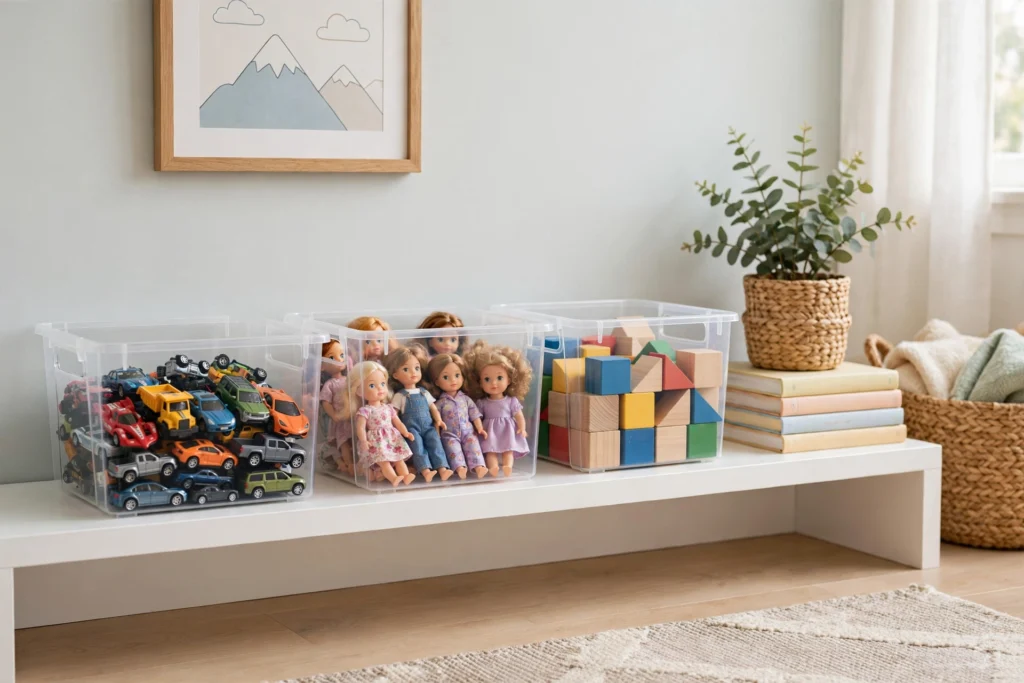
One giant toy bin becomes a mixed-up excavation site within days. Four small bins ($6–10 each) — cars, dolls, blocks, art — stay sorted because each holds one category and a kid can see the bottom. Small bins also mean small messes when dumped, which is inevitable.
6. Give LEGO its own system
LEGO deserves special treatment because it’s the messiest toy ever invented. A play mat that cinches into a storage bag ($20–30) lets kids dump, play, and scoop everything back in one motion. For serious collections, sort by type (bricks, minifigs, specialty) into stackable drawers — never by color, which no kid maintains.
7. Corral stuffed animals vertically
Stuffed animals multiply and eat beds. A hanging mesh organizer ($10–15) on the back of the door or a corner hammock ($12–18) gets them off the bed and floor while keeping them visible and huggable. Set a limit together: the hammock holds what fits; overflow gets donated.
8. Create an art supply caddy
Art supplies spread like glitter because they’re used everywhere. One portable caddy ($10–15) holds crayons, markers, paper, and stickers — art happens at the table, then the caddy goes back to its shelf. Add a rule: the caddy lives on its shelf, not on the floor. Refill paper monthly.
Zones for Small Rooms
Even a tiny kids’ room needs three zones — sleep, play, and (for school-age kids) homework. Zones prevent every activity’s stuff from colonizing the whole room.
9. Define zones with rugs and furniture
A play rug marks the play zone; the desk (even a small wall-mounted fold-down, $40–70) marks homework. You don’t need dividers — a rug and furniture placement is enough for a kid’s brain to register “this area is for this.” Keep toys out of the sleep zone so bedtime doesn’t become playtime.
10. Use under-bed storage for off-season and overflow
The space under the bed is prime real estate: flat bins ($12–20 each) hold off-season clothes, extra bedding, or the toy rotation stash. Kids can slide them in and out themselves. Label the ends so the right bin comes out.
11. Maximize closet with double rods and bins
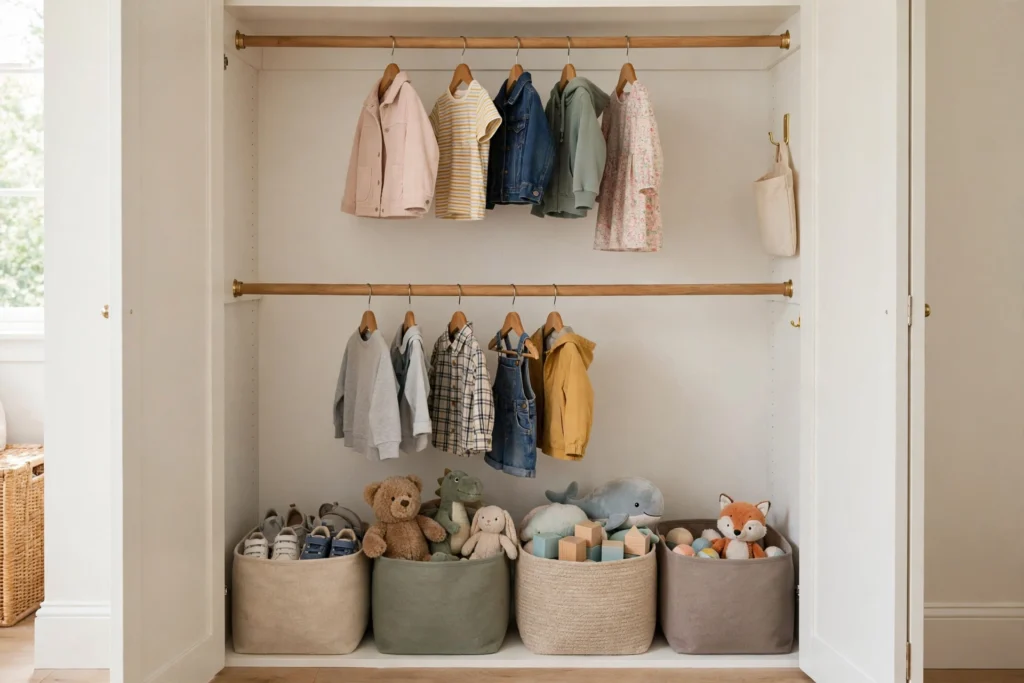
Most kids’ closets waste the lower half. Add a second rod ($15–25) at kid height for their daily clothes — independence and organization in one. Floor bins hold shoes and bulky toys. If they can reach it, they’ll use it; if they can’t, you become the closet butler.
Clothes Without the Floor-Drobe
The “floordrobe” — clean-ish clothes living on the floor — is a universal kid phenomenon. Shrink it with systems.
12. Simplify the wardrobe
Kids need far fewer clothes than they own. Keep one week’s worth accessible: 7 tops, 7 bottoms, plus layers. The rest goes to storage or donation. Fewer clothes means the dresser actually closes, laundry is manageable, and getting dressed takes five minutes instead of twenty.
13. Use picture labels on drawers
Label dresser drawers with pictures (shirts, pants, pajamas) for young kids, words for older ones. When the drawer says what’s inside, clothes go back in the right place — most floordrobes happen because putting away feels like a puzzle.
Habits Without Nagging
Systems need maintenance, and kids need ownership. These make tidying theirs, not yours.
14. The 5-minute toy sweep before dinner
One timer, five minutes, everyone picks up. Make it a race, play music, or do it together — the format matters less than the consistency. Five minutes daily prevents the weekend disaster-clean that makes everyone miserable. Start tonight; it works from day one.
15. One in, one out for toys
New birthday haul? Something old gets donated before the new stuff gets shelved. This stops the slow accumulation that silently doubles toy volume every year, and it teaches generosity as a side effect. Kids accept this rule surprisingly well when it’s consistent.
Your Kids Room Checklist
Kid Logic Setup
- Everything visible and at kid height
- One obvious home per category (picture/word labels)
- Purge completed together (keep/donate/trash/relocate)
Toy Storage
- Toy rotation started (half stored away)
- Small category bins (not one giant box)
- LEGO system (cinch mat or sorted drawers)
- Stuffed animal hammock or door organizer + limit set
- Art caddy with a home shelf
Zones
- Sleep, play, homework zones defined
- Under-bed bins labeled and in use
- Closet double rod at kid height
Clothes
- Wardrobe simplified to one week + layers
- Drawer labels (pictures or words)
Habits
- 5-minute pre-dinner toy sweep
- One-in-one-out for toys enforced
What Actually Works (and Common Mistakes)
The specifics that make the difference, with safety points checked against the public sources listed below.
- Anchor first. Kids climb drawers and shelves. CPSC’s Anchor It! campaign says anchoring furniture with drawers, doors and shelves to the wall prevents tip-over injuries and deaths, and the kits take minutes to install.
- Picture labels for non-readers. A printed photo of the toy on each bin lets a four-year-old clean up without help.
- Rotate toys. Keep roughly a third out and the rest stored; swap every couple of weeks. Fewer toys out means faster cleanups and more play with each one.
- Hang hooks and rods low. About 36 to 42 inches lets most young kids hang their own jacket and backpack; raise them as they grow.
- Prefer lidless bins. Open bins are easier for kids and avoid lids slamming on fingers.
Common mistakes
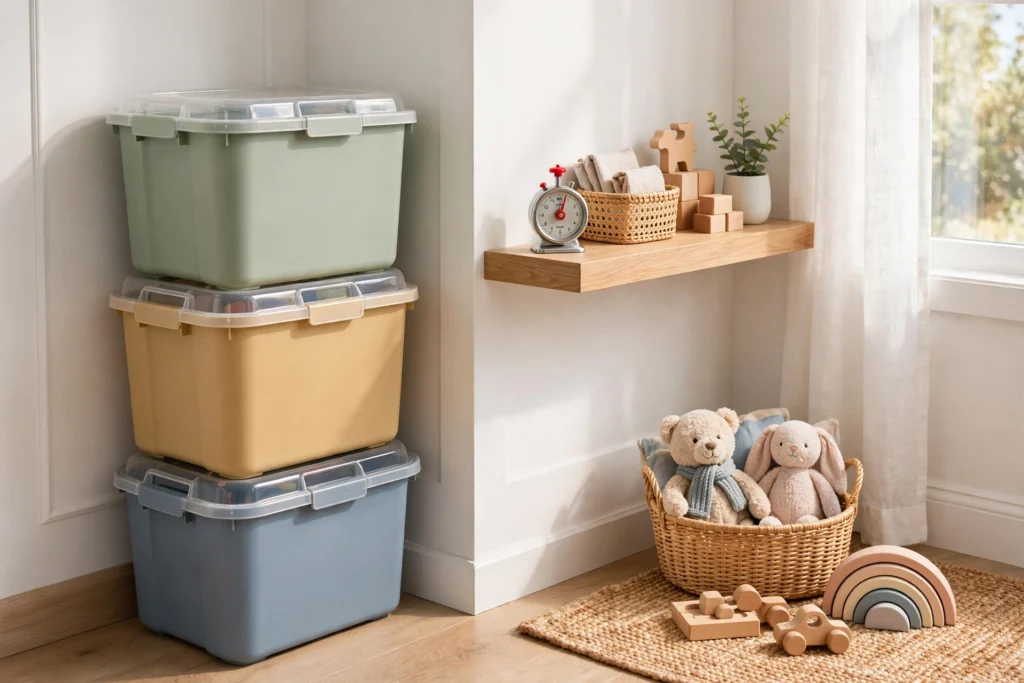
- Tall stacks of heavy bins that a child pulls down from the bottom.
- Too many tiny categories; ‘cars’, ‘blocks’ and ‘dolls’ beats twelve labels.
- Keeping spare button batteries, medicines or cosmetics in the kids’ room.
Sources & safety notes: CPSC Anchor It! campaign (furniture and TV tip-overs). Safety points were checked against these pages on November 1, 2026. Spot something wrong? Tell us and we will correct it.
Related guides
Save this for later
Pin this image to your Pinterest board so it’s there when you need it.
 Save to Pinterest
Good to know: Anchor every dresser, bookcase and toy shelf to the wall. The CPSC’s Anchor It! campaign shows how to fit an anti-tip kit in minutes.
FAQ
How do I get my kids to keep their room clean? Make it easy, not strict: visible low storage, one home per toy category, and half the toys in rotation. Then add the 5-minute daily sweep. Kids maintain systems designed for them; they rebel against systems designed for adults.
What age should kids organize their own room? Toddlers (2–3) can do the 5-minute sweep with you guiding. By 5–6 they can maintain labeled bins independently. By 8–10 they can manage their whole system including the wardrobe. Start the habits early and the capability follows.
How many toys should a kid have? Fewer than you think. If the storage is overflowing, there are too many — rotate half away and see if they’re missed (they won’t be). Most families find kids play more deeply with fewer toys. Quality over quantity, always.
Design for the kid, not the camera, and the room stays tidy long after the organizing high wears off.
Free printables: grab our Room-by-Room Cleaning Checklist and Weekly Reset Planner — add the 5-minute toy sweep to your family’s weekly reset.
Keep going: small bedrooms need the same zone thinking — Small Bedroom Organization Ideas covers the adult version. Under-bed space pulling double duty? 19 Under-Bed Storage Ideas maximizes every inch. And when the toys have simply multiplied beyond reason, the 30-Day Decluttering Checklist helps the whole family purge together.
Pingback: 12 Mudroom Organization Ideas for Busy Families - Neat Freak Nest