
To organize a mudroom, give each person their own hook, cubby or bin, put shoes on a boot tray right by the door, and move off-season gear up high or elsewhere so only this week’s things live there. Even a 4-foot stretch of wall with a bench, hooks and a shelf works if every item has one spot; these mudroom organization ideas show how.
⏱️ Short on time?
Grab our FREE printable checklists — the exact routines behind every calm home on this blog:
📋 Room-by-Room Checklist (PDF)📅 Weekly Reset Checklist (PDF)
Part of our Living Room, Bedroom & Holiday Storage Guide, which brings every related post together in one place.
Here’s the truth: mudroom chaos isn’t a discipline problem, it’s a systems problem. When every item has an obvious, easy home, even kids will put things away — because it’s actually easier than dropping them on the floor. These 12 ideas build a mudroom system that handles real family life: the morning rush, the after-school dump, and the seasonal gear avalanche.
The Core Principle: One Home Per Person
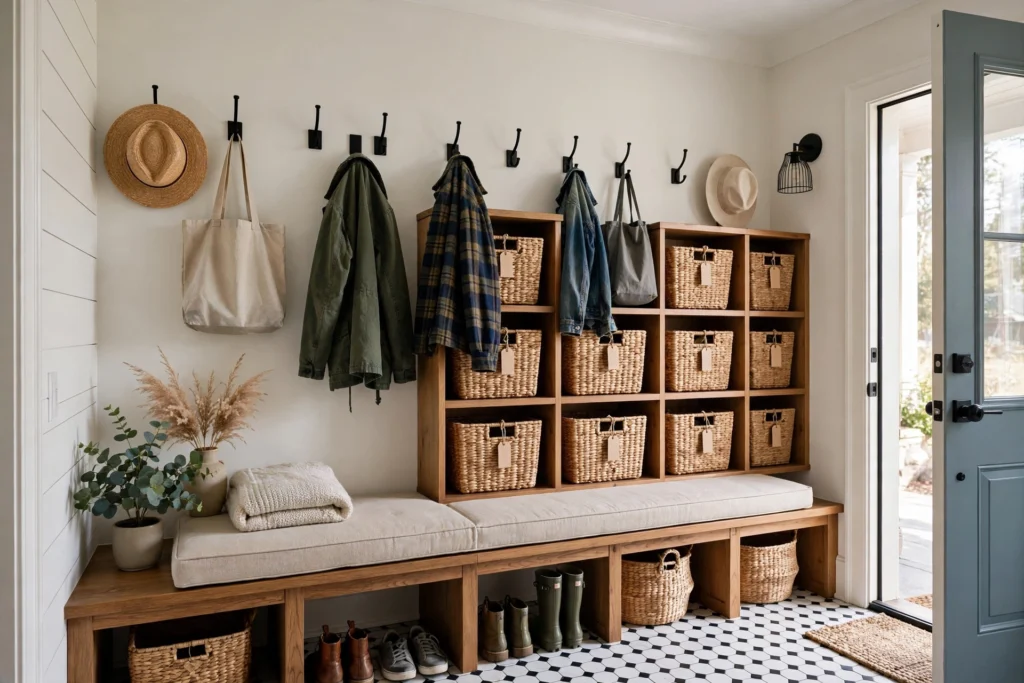
Before any product or project, establish this rule: every family member gets ONE designated spot for shoes, ONE hook for their coat, and ONE bin or cubby for their stuff. When spots are assigned, there’s no decision to make — shoes go in YOUR cubby, coat on YOUR hook. Label everything with names (a $10 label maker pays for itself here). This single change eliminates 80% of mudroom mess.
Shoe Systems That Actually Work
1. Cubbies beat shoe racks for families
Open shoe racks look tidy in photos and chaotic in real life — shoes slide off, pairs separate, and boots don’t fit. Individual cubbies (one per person, sized at least 12″ wide × 14″ deep) keep pairs together and contain the sprawl. A 4-cubby bench unit runs $80–$150 at Target or IKEA (the TRONES or BESTÅ systems work well). Each person’s shoes live in their cubby — when it’s full, that’s the signal to put pairs away in closets.
2. Add a boot tray for wet and muddy days
A simple boot tray ($15–$25) under the shoe area catches mud, snow, and rain before it hits your floor. Look for one with raised ridges that keep shoes elevated above the water line. In winter, this one tray saves your floors from daily salt-and-slush damage. Empty and wipe it weekly.
3. Enforce the “two-pair rule”
Each person keeps a maximum of two pairs in the mudroom: the daily pair and the weather pair (boots in winter, sandals in summer). Everything else lives in bedroom closets. This is the rule that prevents the shoe pile from regenerating. It takes one 10-minute purge to implement and saves daily frustration forever.
Coat and Jacket Solutions
4. Hooks at kid height (this changes everything)
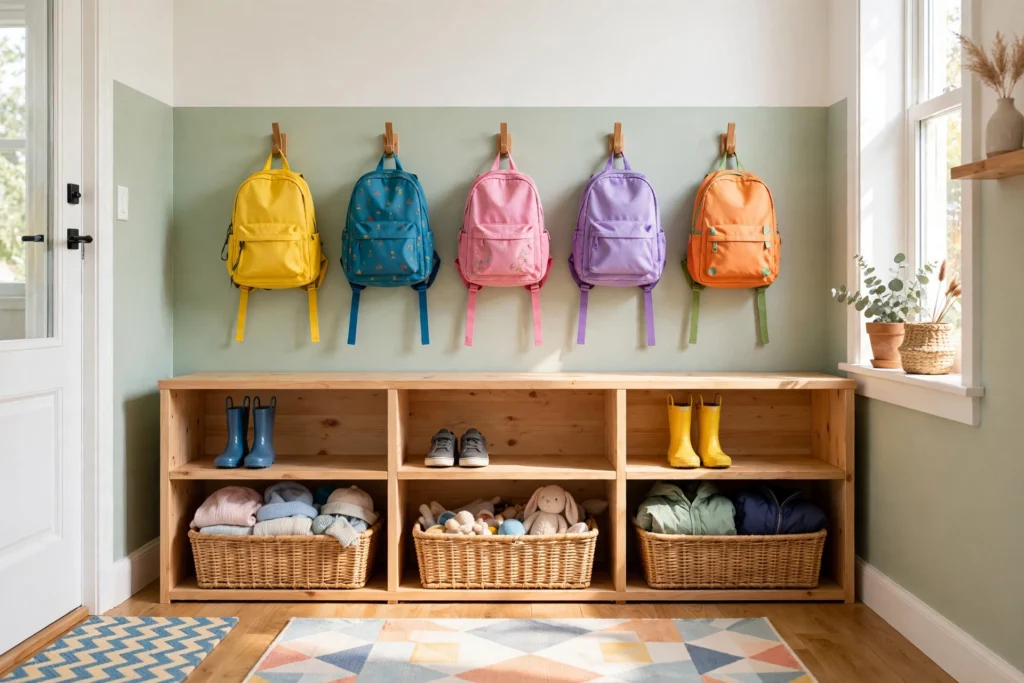
Standard hooks are mounted at 60″ — perfect for adults, unreachable for anyone under 10. Mount a second row of sturdy hooks at 36–40″ for kids. When kids can actually reach their hook, coats magically stop landing on the floor. Use double hooks ($3–$5 each) so each hook holds a coat plus a backpack.
5. One hook per person, no sharing
Shared hooks become coat avalanches — three jackets on one hook means all three end up on the floor. Assign one hook per family member and label it. If you’re short on wall space, a freestanding coat rack ($30–$50) adds 8–12 hooks without any installation.
6. Seasonal coat rotation
In October, pack away lightweight jackets. In April, store the heavy parkas. The mudroom should only hold current-season outerwear — off-season coats go in a hall closet or under-bed bins. A mudroom stuffed with four seasons of jackets has no room to function. While you’re at it, our entryway organization ideas cover the same rotation principle for front-entry spaces.
Backpack and School Gear Stations
7. Create a launch pad per kid
The “launch pad” is a designated spot where each child’s school essentials live: backpack, lunchbox, water bottle, and shoes. A cubby + hook combo per kid IS the launch pad. The magic rule: backpacks get packed the night before and placed on the launch pad. Mornings become grab-and-go instead of a scavenger hunt. Our kids room organization ideas have matching systems for homework and school supplies upstairs.
8. Use a wall-mounted file organizer for papers
School papers are the invisible mudroom clutter — permission slips, artwork, lunch menus pile up on every flat surface. Mount a simple wall file organizer ($12–$20) with one slot per kid labeled “IN” — papers go there, not on the bench. Sort it every Sunday: keep, act on, or recycle. Five minutes a week prevents the paper avalanche.
9. Charging station for devices
Older kids’ tablets, headphones, and school devices need a home too. A small charging station ($25–$35) with a power strip inside a ventilated box keeps devices charged and contained. Devices charge overnight in the mudroom, not scattered across bedrooms — which also happens to solve the “phone in bed” problem.
Storage and Bench Ideas
10. A bench with hidden storage is non-negotiable
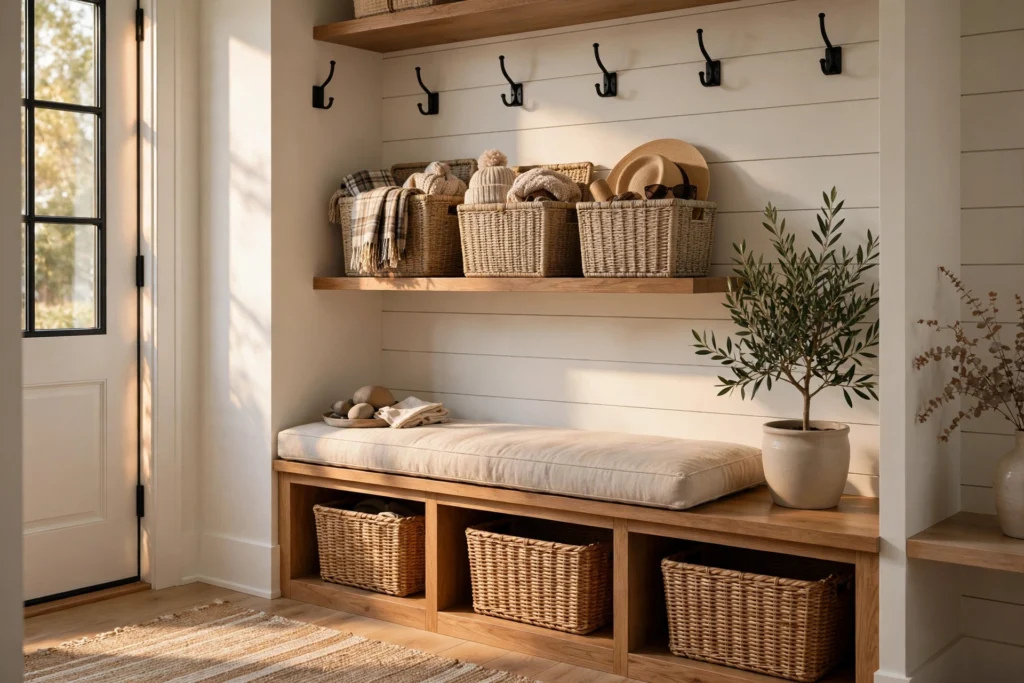
A mudroom bench isn’t just for sitting — it’s prime hidden storage. A storage bench ($100–$180) holds sports equipment, reusable grocery bags, pet supplies, and all the miscellaneous gear that otherwise lives on the floor. The bench top stays clear for sitting (to put on shoes), and everything else disappears inside. Measure your space first: you need at least 36″ wide for a functional bench.
11. Overhead shelves for out-of-season gear
Install a shelf 12–18″ below the ceiling ($20–$30 in brackets and a pine board) for items you need but not daily: beach bags in winter, sleds in summer, the soccer ball bag during basketball season. Label bins up there clearly — you’ll forget what’s in them otherwise. This uses dead vertical space that most mudrooms waste entirely.
12. Seasonal gear rotation bins
Keep two labeled bins in the mudroom: “CURRENT SEASON” and “NEXT SEASON.” When the weather shifts, swap them — winter hats and gloves come out, sunscreen and bug spray go in. The bins live on the overhead shelf or in the bench. This 10-minute seasonal swap, done 4 times a year, keeps the mudroom matched to real life instead of drowning in off-season stuff. For the full seasonal approach, our weekly reset routine includes a monthly seasonal check that pairs perfectly with this.
Small Mudroom? No Mudroom? Solutions
Not everyone has a dedicated mudroom. These ideas work in any entry space:
- No mudroom at all: Create a “mudroom wall” in your entryway or garage — a 4-foot section with hooks, a narrow bench, and a boot tray. You don’t need a room; you need a system.
- Tiny mudroom: Go vertical. Floor-to-ceiling hooks, overhead shelves, and a wall-mounted fold-down bench ($60–$90) that disappears when not in use.
- Garage entry: The garage is actually ideal — mess stays out of the house entirely. Add a washable rug runner ($25–$40), hooks on the wall, and cubbies. Just make sure it’s well-lit so the family actually uses it.
- Apartment: An over-the-door hook rack ($15–$20) plus a slim shoe cabinet (IKEA TRONES, $40 for a 3-pack, only 7″ deep) creates a micro-mudroom in any hallway.
The Mudroom Reset Checklist
Initial Setup (one afternoon):
– Assign one cubby, one hook, and one bin per person — label everything
– Mount kid-height hooks (36–40″)
– Purge to two pairs of shoes per person in the mudroom
– Set up boot tray for wet weather
– Install overhead shelf for out-of-season gear
– Create launch pads with backpack + essentials per kid
– Mount wall file organizer for school papers
– Rotate to current-season coats only
Weekly (5 minutes):
– Return stray items to assigned spots
– Empty and wipe boot tray
– Sort school paper organizer
Seasonal (10 minutes, 4× per year):
– Swap seasonal gear bins
– Rotate coats for the coming season
– Purge outgrown shoes and jackets for donation
What Actually Works (and Common Mistakes)
The specifics that make the difference, with safety points checked against the public sources listed below.
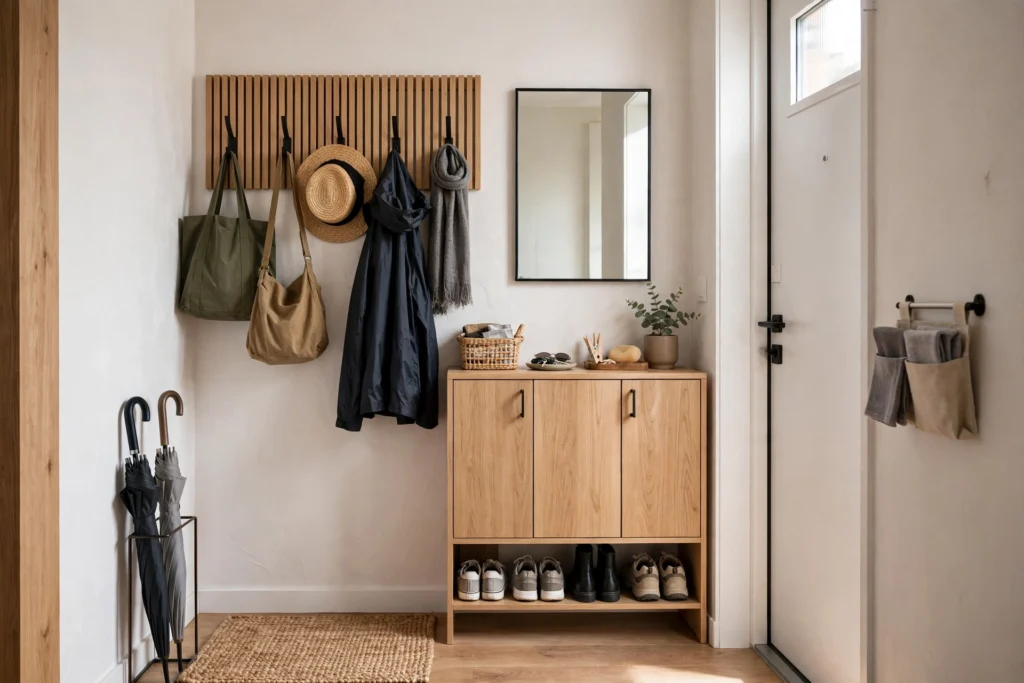
- Plan two hooks per person, at their height. Roughly 36 to 48 inches for younger kids and 60 to 66 inches for adults, so everyone can hang their own coat and bag.
- Use doormats on both sides of the door. EPA recommends doormats outside and inside every entry and taking shoes off at the door to cut down on soil, including lead-contaminated soil, tracked into the house.
- Let wet gear dry before storing it. A ridged boot tray keeps shoes out of meltwater. Hang wet coats and gloves in the open; EPA advises drying damp items within 24 to 48 hours to prevent mold.
- Choose open or ventilated bins for hats and gloves. Wire or open-weave baskets breathe; closed plastic tubs trap damp.
- Anchor tall lockers and cubbies. Kids climb them. CPSC’s Anchor It! campaign recommends anchoring furniture with drawers, doors and shelves to the wall.
Common mistakes
- Too few hooks, so coats pile on top of each other.
- Closed bins for wet winter gear.
- A bench that becomes a shelf; keep the seat clear so people actually sit to take shoes off.
Sources & safety notes: EPA: Protect Your Family from Sources of Lead · EPA: A Brief Guide to Mold, Moisture and Your Home · CPSC Anchor It! campaign (furniture and TV tip-overs). Safety points were checked against these pages on November 1, 2026. Spot something wrong? Tell us and we will correct it.
Save this for later
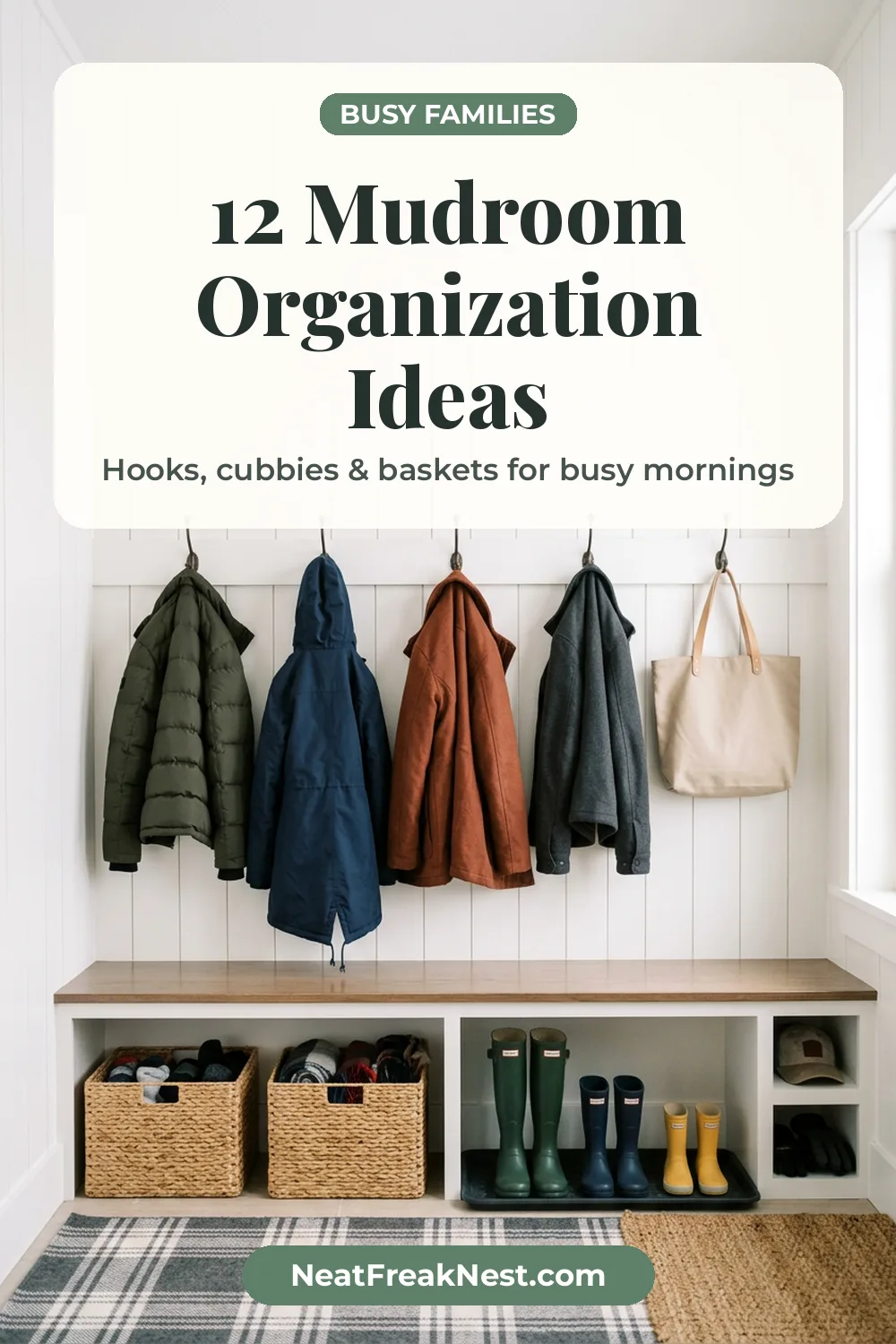
Pin this image to your Pinterest board so it’s there when you need it.
Mudroom Organization Ideas FAQ
How do I organize a mudroom with no built-ins?
You don’t need built-ins — you need zones. A freestanding cubby bench ($80–$150), wall-mounted hooks ($3–$5 each), a boot tray ($15–$25), and labeled bins create a complete system with zero construction. The one-home-per-person principle matters more than any furniture.
How do I get my kids to actually use the mudroom system?
Three things: hooks at their height (36–40″), labeled spots with their names on them, and making the system easier than the floor. If the cubby is right where they walk in and the hook is at eye level, putting things away takes less effort than dropping them. It takes about two weeks of gentle reminders, then it becomes habit.
What should I store in a mudroom vs. elsewhere?
Mudroom = daily in-and-out items only: current-season coats, two pairs of shoes per person, backpacks, keys, sunglasses, reusable bags, and current sports gear. Everything else — off-season coats, extra shoes, occasional gear — lives in closets, the garage, or overhead storage. The mudroom stays functional only when it holds today’s stuff, not everything you own.
Want the printable version? Join the Neat Freak Club — it’s free! Get the mudroom setup checklist and per-person label templates as printables, plus our entryway organization planner.
Pingback: 19 Garage Organization Ideas That Finally Fit the Car
Pingback: 19 Coat Closet Organization Ideas for a Tidy Entryway