
Open your spice cabinet and what do you see? For most of us, it’s a dark, crowded shelf where paprika hides behind cinnamon, three half-empty oregano jars jostle for space, and finding the cumin means pulling out six bottles first. Spices are one of the cheapest ways to make food taste amazing — but only if you can actually find them when you need them. These spice cabinet organization ideas make every jar easy to spot and grab.
⏱️ Short on time?
Grab our FREE printable checklists — the exact routines behind every calm home on this blog:
📋 Room-by-Room Checklist (PDF)📅 Weekly Reset Checklist (PDF)
Part of our Kitchen Cleaning & Organization Guide, which brings every related post together in one place.
The good news: a spice cabinet is one of the fastest organization wins in the whole kitchen. It’s a small, contained space, so even an hour of work transforms it completely. You’ll cook faster, waste less food on half-stale spices, and stop buying duplicates you already own. Below are 19 practical spice cabinet organization ideas that work in real kitchens — apartments, rentals, and deep cabinets included. Pick the ones that match your space and you’ll wonder why you cooked any other way.
Zone 1: See Everything — Visibility Fixes
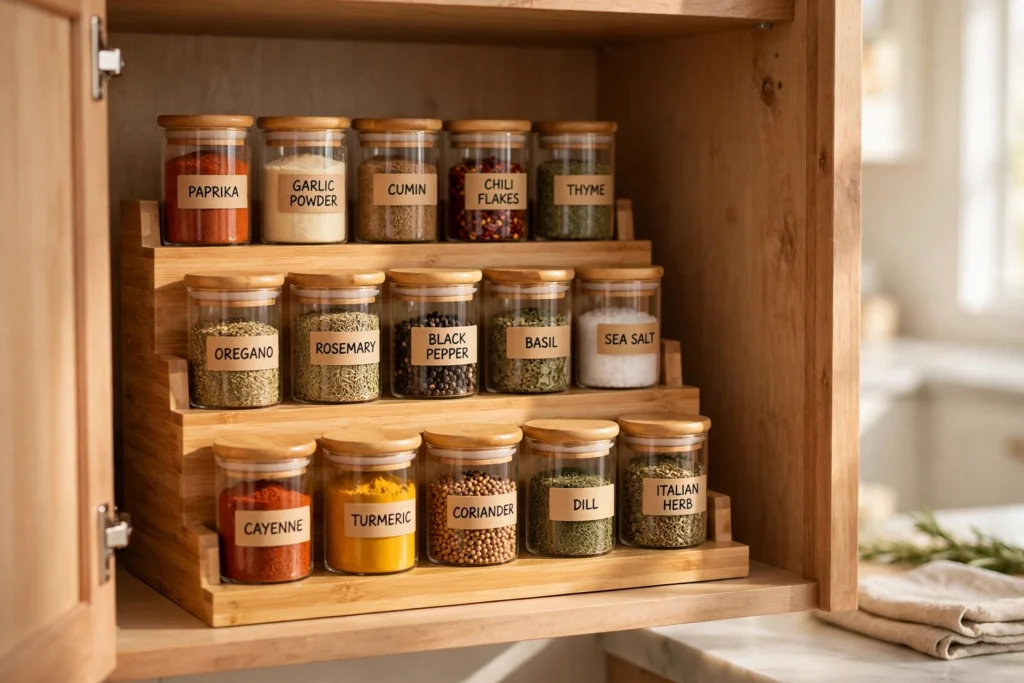
1. Use tiered risers so no jar hides behind another
The single biggest problem in spice cabinets is depth: front jars hide back jars. Tiered risers (stadium-style steps) lift the back rows so every label faces you. A two- or three-tier riser for a standard cabinet costs around $10–15 and instantly ends the reach-and-guess game.
2. Decant into matching jars with labels
Mismatched bottles from five different brands are visual chaos, and half of them don’t show the level of what’s inside. Transfer spices into uniform glass jars with airtight lids, then label them. You can see exactly when you’re running low — and the cabinet goes from junk-drawer energy to intentional in one move.
3. Label the tops, not just the fronts
If your jars sit on a single shelf, label the lids. When you’re looking down into a cabinet or drawer, the top is the only label you can read. Waterproof chalkboard or vinyl labels run a few dollars for a big pack and survive kitchen humidity.
4. Store alphabetically (seriously)
It sounds fussy, but alphabetizing is the fastest retrieval system ever invented — no thinking, no scanning every bottle. Allspice to turmeric, left to right. New jar? It has a guaranteed slot, which means it never becomes a loose wanderer on the shelf.
Zone 2: Use the Whole Cabinet — Space Multipliers
5. Add a pull-out drawer insert
Deep base cabinets swallow spices whole. A sliding pull-out insert turns the entire depth into usable space — the whole tray glides out so you can see everything at once. These run $20–40 and install in minutes; for renters, freestanding sliding organizers work without screws.
6. Mount racks on the inside of the cabinet door
The back of the door is free real estate. Slim door-mounted spice racks hold 10–20 jars using space that was doing nothing. Measure first: make sure the racks clear the shelf edges when the door closes. Most racks install with two screws or strong adhesive strips, so renters can use the no-drill versions without worry.
7. Use a lazy Susan for corner cabinets
Corner cabinets are where spices go to disappear. A turntable (lazy Susan) with raised edges lets you spin to whatever you need — nothing hides in the blind corner anymore. Two-tier turntables double the capacity for about $15.
8. Go vertical with wall-mounted magnetic jars
If the cabinet is truly full, move spices out of it entirely. Magnetic jars on a steel board mounted on the wall beside the stove free up the cabinet for other things — and your most-used spices sit at eye level, one glance away. Great for renters with adhesive-mount boards.
Zone 3: Drawer Storage — The Pro Move
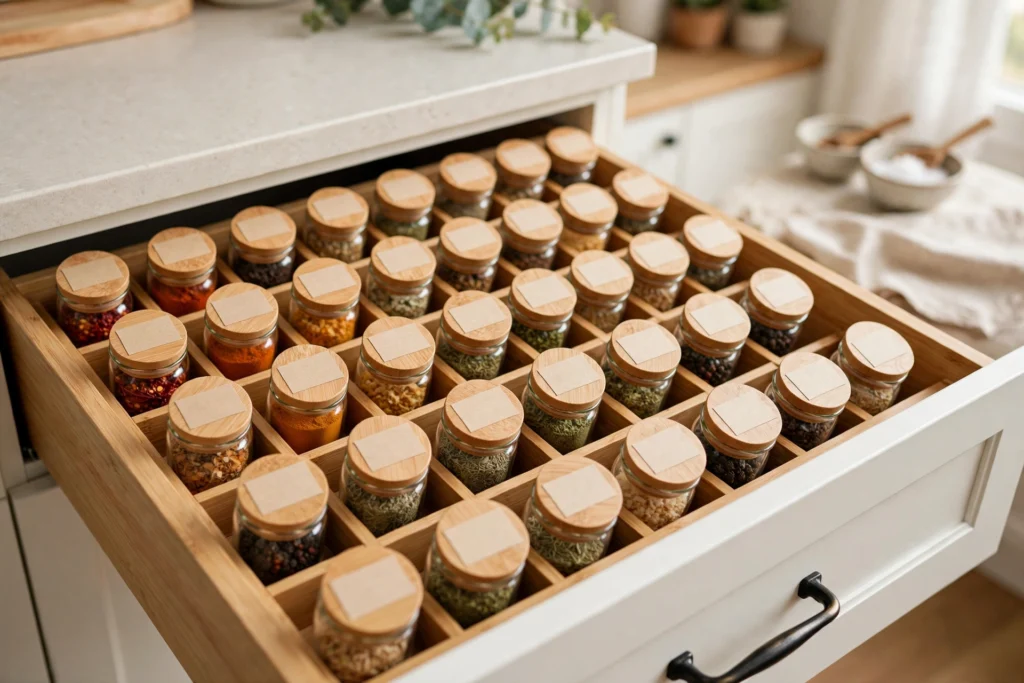
9. Convert a drawer to a spice drawer
Many cooks swear the spice drawer beats the cabinet: jars lie on their sides in angled inserts, every label facing up, nothing hidden. A bamboo or expandable spice drawer insert ($15–25) turns any shallow drawer into a spice display you can scan in two seconds.
10. Use angled drawer inserts for instant scanning
If you already store spices in a drawer, angled inserts are the upgrade. The tilt puts every label at readable angle and stops jars rolling around. Expandable versions adjust to odd drawer widths without measuring perfectly.
Zone 4: Systems That Keep It Tidy
11. Keep a “daily spices” zone near the stove
Salt, pepper, garlic powder, olive oil, and whatever your household reaches for most deserve front-row real estate — ideally within arm’s reach of the stove. The once-a-month specialty spices live in the back. Organize by frequency of use and you stop rearranging the whole cabinet every dinner. This one habit alone cuts cooking prep time more than any organizer purchase.
12. Retire duplicates and expired jars
Ground spices lose their punch after about a year (whole spices last longer). Before you buy any organizer, do a ruthless purge: smell-test anything questionable, merge the three half-jars of oregano into one, and recycle empties. Most cabinets lose a third of their volume in this step alone.
13. Group by cuisine, not just alphabet
If you cook by theme — taco nights, Italian, Indian — group those spices together. Cumin, coriander, turmeric, and garam masala become one grab-and-go cluster. Alphabetical still wins for findability, but cuisine grouping wins for speed when you’re mid-recipe.
14. Use small bins to corral categories
Small open bins inside the cabinet act like drawers within shelves: one bin for baking spices, one for savory, one for blends. Pull out the bin instead of six jars. Clear acrylic or bamboo bins ($8–12 for a set) keep it tidy-looking, too.
15. Buy a backup-stocking rule, not more shelves
Spice clutter often comes from buying: backup paprika joins the half-used paprika. New rule — no backup buys until the current jar is finished, except the three you use most. Less inventory, less chaos, less money. Write the exception list on a sticky note inside the cabinet door so the whole household follows it.
Zone 5: Small-Kitchen and Renter Tricks
16. The slim gap between fridge and counter
That 6-inch gap beside the fridge fits a narrow rolling spice cart perfectly — a renter-favorite for kitchens with zero cabinet space. It rolls out for full visibility and tucks away invisibly. Often under $30.
17. Over-the-door pantry rack for spice overflow
When the cabinet is full but you keep collecting spices, an over-the-door rack on the pantry door absorbs the overflow with zero damage to the rental. Shallow racks with raised rails keep jars from tumbling when the door swings.
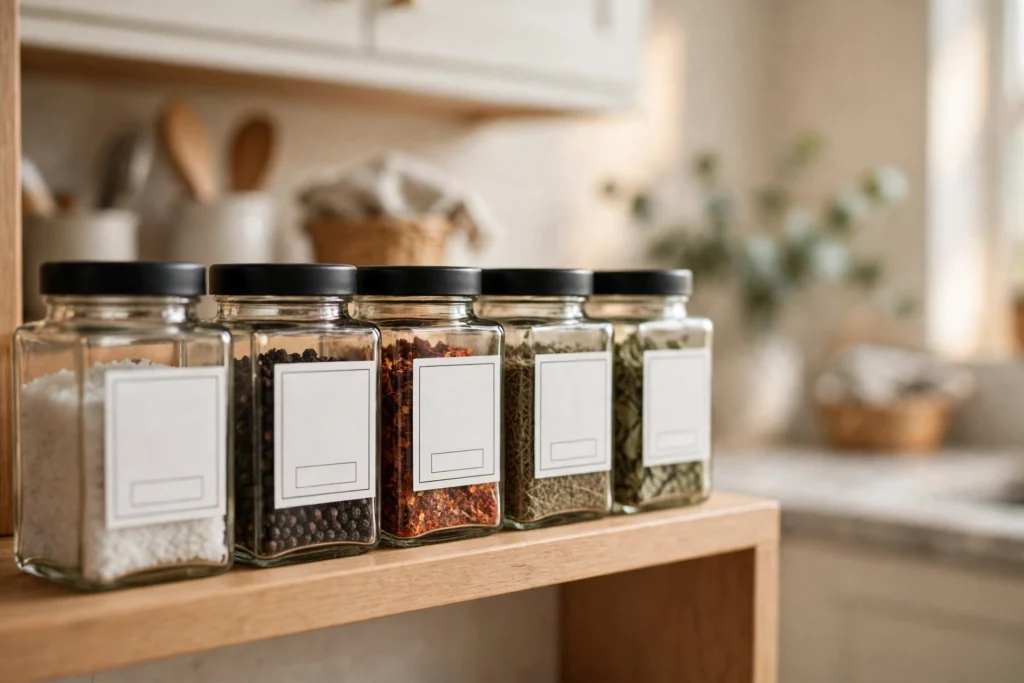
18. Decant into stackable square jars
Round jars waste the corners of every shelf. Square or rectangular jars nest edge-to-edge and stack cleanly, squeezing noticeably more capacity into the same cabinet footprint — a cheap density upgrade for small kitchens.
19. Keep a tiny “tasting shelf” for new spices
Reserve one small corner — a tray, a bin, one shelf — for spices you’re trying out. New blends stay quarantined until you decide whether they earn permanent status. It stops experimental jars from infiltrating your core system.
Quick-Start Plan: If You Only Do 5 Things
- Purge expired jars and merge duplicates (#12)
- Add a tiered riser so every jar is visible (#1)
- Label every jar and lid (#3)
- Create a daily-use zone near the stove (#11)
- Store spices alphabetically (#4)
These five take one afternoon and fix about 90% of spice cabinet chaos.
Related reading: once the spices are sorted, take on the whole pantry — and if your kitchen is short on space overall, these small kitchen organization ideas help every cabinet pull its weight. Budget shoppers: the Dollar Tree finds roundup has labels and bins that look far pricier than they are.
Save this for later
Pin this image to your Pinterest board so it’s there when you need it.
Good to know: Keep spices in a cool, dry cabinet away from the stove. The USDA’s shelf-stable food guide covers how heat and moisture shorten pantry shelf life.
Spice Cabinet Organization Ideas FAQ
Where is the best place to store spices in the kitchen?
In a cool, dark spot away from the stove’s heat and the dishwasher’s steam — a cabinet, drawer, or pantry shelf works best. Heat and light fade flavor faster, so the cabinet right above the range is actually the worst spot — move those spices to a cooler cabinet even if it’s a step further away.
How do you organize spices in a deep cabinet?
Use pull-out sliding inserts or tiered risers so the back rows stay visible and reachable. A lazy Susan also works well in corner cabinets where depth becomes a blind spot.
Should spices be stored in the original containers or decanted?
Decanting into matching airtight jars with labels looks better and makes levels visible, but it’s optional — uniform containers help most in small or visible storage. The real upgrade is labels and visibility, not the jars themselves.
How long do ground spices last?
Ground spices stay potent for about a year; whole spices last two to three years. If a spice has no smell when you open it, it’s done — purge it during your next cabinet reset.
Keep it organized for good: grab our free Spice Cabinet Inventory Printable — a one-page sheet to track what you own, what’s running low, and what expires when, so you never buy your fourth jar of paprika again.
Pingback: 17 Kitchen Countertop Organization Ideas
Pingback: 19 Food Storage Container Organization Ideas