
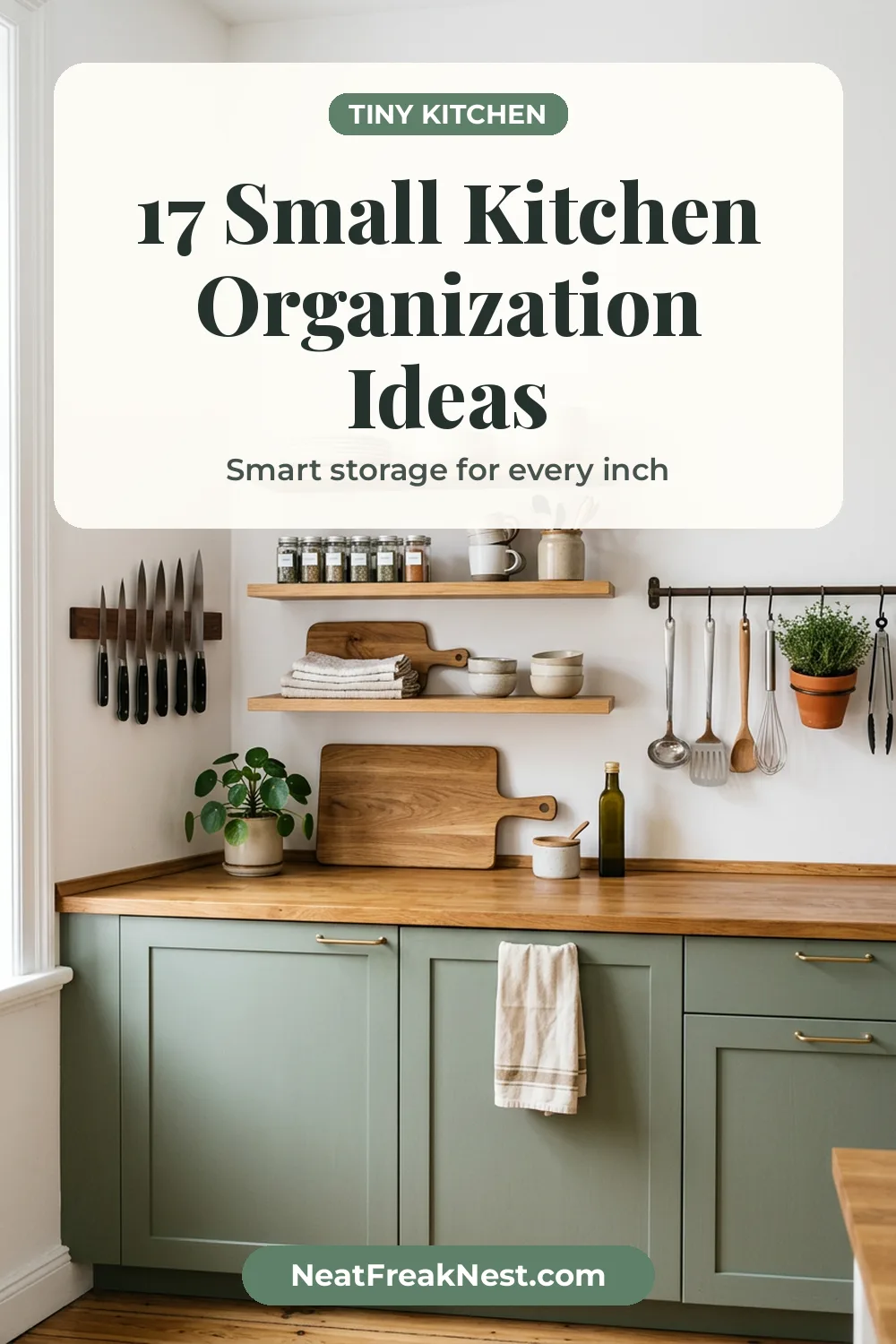
To organize a small kitchen, keep only daily-use appliances on the counter, move everything else into cabinets by how often you use it, and add vertical storage such as shelf risers, door racks and wall rails to double usable space. Start with the counter: relocating one or two appliances often frees a full prep zone, and the small kitchen organization ideas below handle the rest.
⏱️ Short on time?
Grab our FREE printable checklists — the exact routines behind every calm home on this blog:
📋 Room-by-Room Checklist (PDF)📅 Weekly Reset Checklist (PDF)
Part of our Kitchen Cleaning & Organization Guide, which brings every related post together in one place.
Here’s what small-kitchen people learn fast: you don’t need more kitchen. You need every inch working. These 17 ideas reclaim dead space — inside cabinets, on walls, above, below, and behind — and most cost under $25.
Clear the Counters First
Counters are your workspace. In a tiny kitchen, every appliance living on the counter is stealing prep space.
1. Keep only daily items on the counter
Be ruthless: coffee maker and knife block stay if you use them daily. The stand mixer, blender, and air fryer go in a cabinet or on a rolling cart. Most tiny kitchens can free half their counter in twenty minutes just by relocating appliances. If you haven’t used it this week, it doesn’t earn counter space.
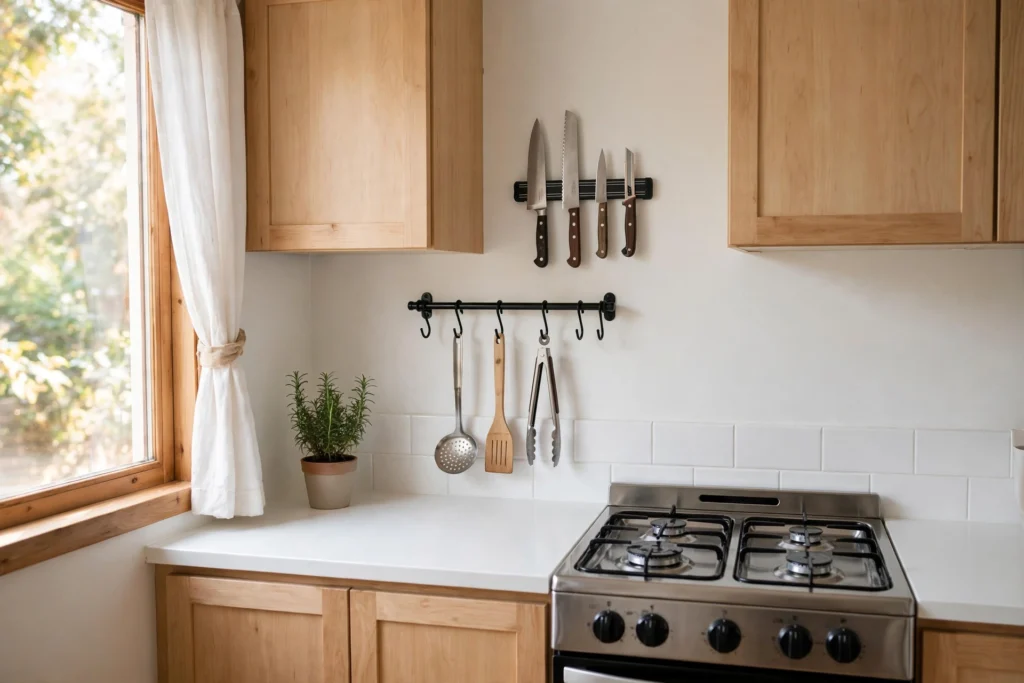
2. Mount a magnetic knife strip
Knife blocks eat a full square foot of counter. A magnetic wall strip ($12–18) holds knives safely on the wall above your prep zone — same access, zero footprint. Mount it at a height kids can’t reach and keep the blades facing up when you place them.
3. Hang utensils on the wall
Spatulas, ladles, and whisks don’t need a drawer. A simple wall rail with S-hooks ($10–15) beside the stove puts every tool within reach while cooking. This frees an entire drawer for the stuff that actually needs to be enclosed.
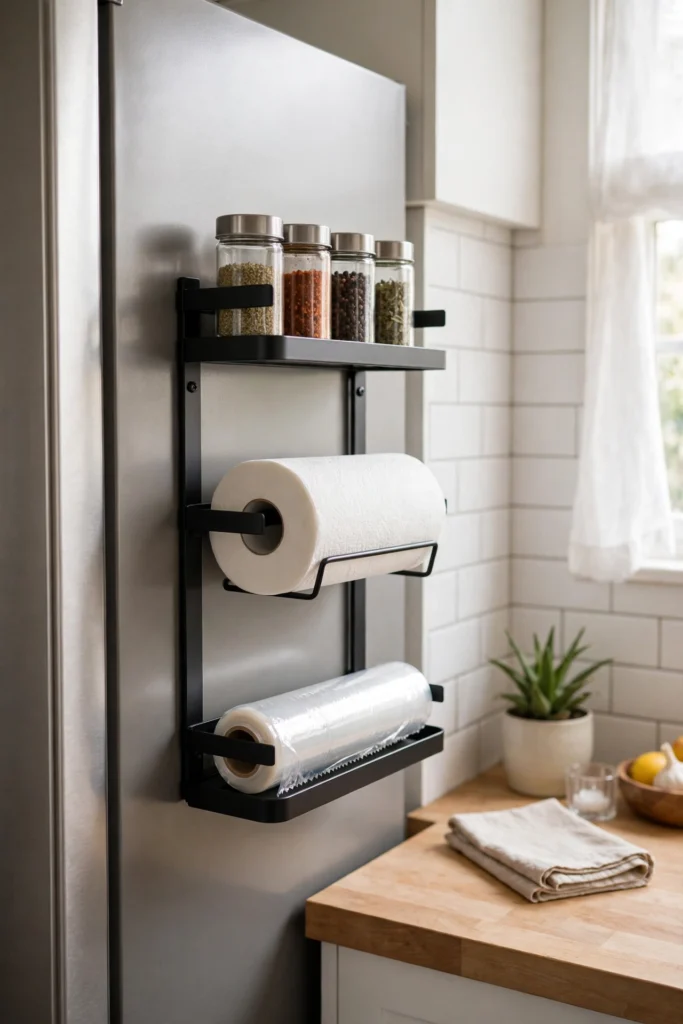
4. Use the side of the fridge
The side of the refrigerator is a full blank wall doing nothing. Magnetic shelves ($15–25) hold spices, paper towels, and wrap — or a magnetic knife strip goes here too if wall space is tight. It’s storage you already own; you’re just finally using it.
Double Your Cabinet Space
Small-kitchen cabinets are usually deep, dark, and half-wasted. These fixes make the inside work as hard as the outside.
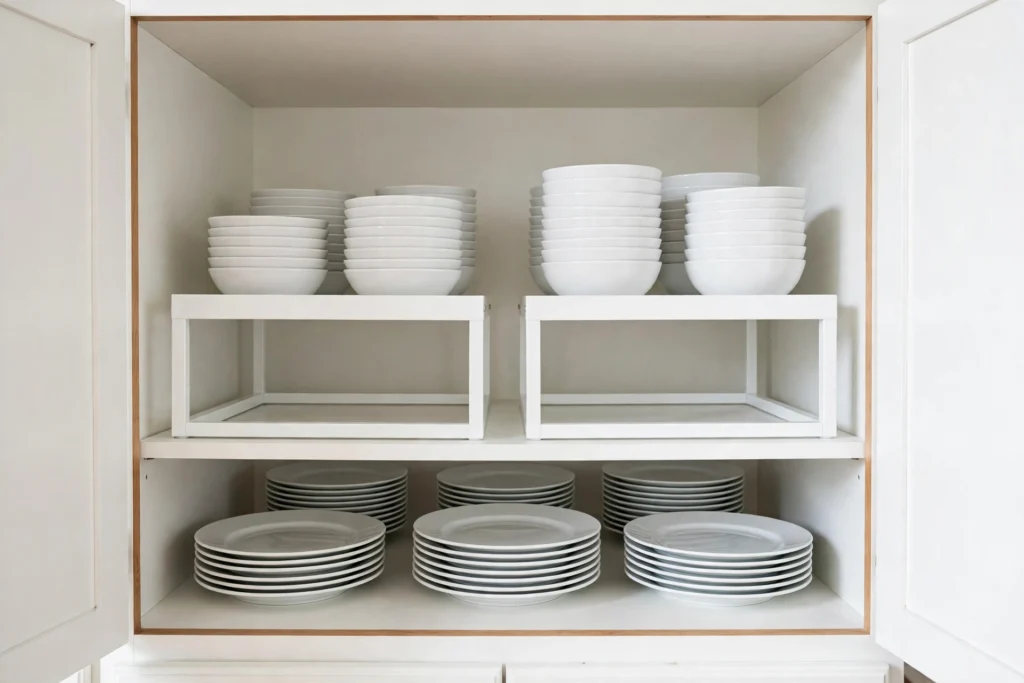
5. Add shelf risers inside cabinets
Cabinet shelves are spaced for tall pitchers, which means plates and bowls waste the air above them. Freestanding shelf risers ($12–20) split each shelf into two levels — dishes below, mugs or bowls above. One riser per shelf roughly doubles dish storage.
6. Install pull-out drawers in base cabinets
Base cabinets are caves — things go in and never come out. Sliding pull-out drawers ($30–50 each) convert the cave into drawers you can actually see into. Start with the one under the sink-side counter where pots live; it’s the highest-friction cabinet in most tiny kitchens.
7. Use the inside of cabinet doors
Adhesive hooks on the inside of cabinet doors hold measuring cups, pot lids, and wraps. A narrow wire rack ($8–12) on the inside of the under-sink door corrals sponges and brushes. Check clearance before you buy — items must be slim enough that doors close fully.
8. Stack pots with pan protectors
Nesting pots without protection scratches them and makes the stack wobble. Felt or fabric pan protectors ($10 for a set) let you nest safely and slide pans out without lifting the whole tower. Store lids vertically in a $12 lid organizer beside the stack instead of on top — lids are what make pot piles collapse.
9. Decant dry goods into uniform containers
In a tiny kitchen, the pantry might be one cabinet. Uniform airtight containers ($25–35 for a set) stack perfectly and eliminate the dead air of half-empty boxes. Square containers waste less space than round ones — geometry matters when inches count.
Steal Space From Walls and Doors
When cabinets are full, the walls, doors, and ceiling are still empty.
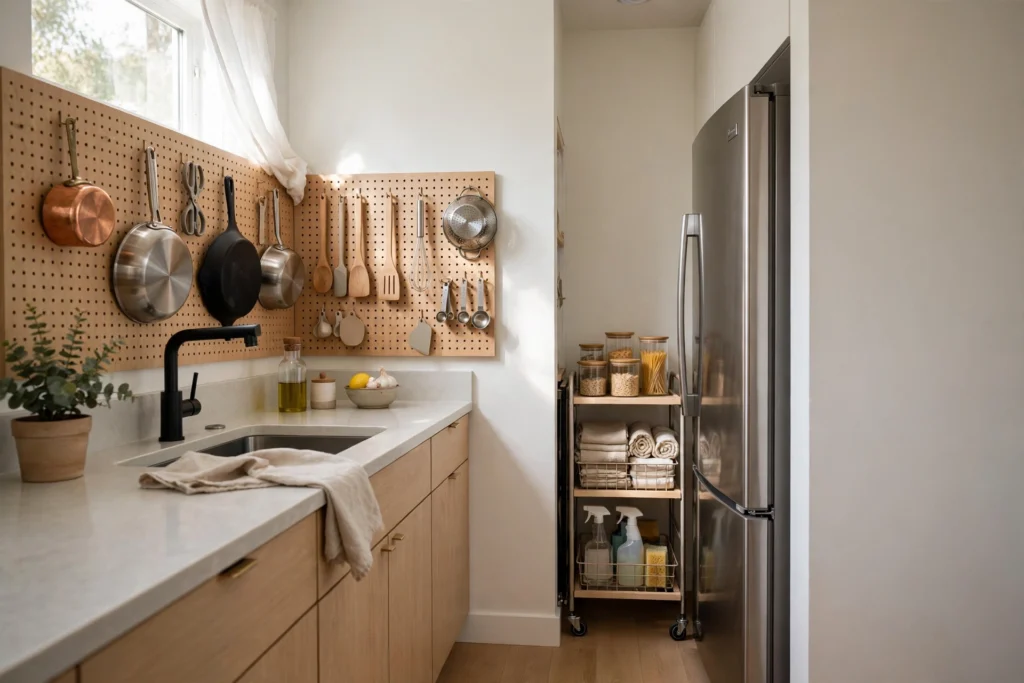
10. Add a pegboard wall
A small pegboard ($20–30) on any free wall section holds pots, pans, utensils, and even small shelves — fully customizable and renter-friendly with the right anchors. Arrange it around how you cook: everyday pans at arm height, rarely-used items up high.
11. Hang a pot rack from the ceiling
If cabinet space is truly gone, a ceiling pot rack ($30–50) moves the bulkiest items overhead. Check that you have a joist to anchor into — drywall anchors alone won’t hold cast iron. Keep daily pans lowest on the rack.
12. Put a rolling cart in the gap
That 8-inch gap between the fridge and the wall? A slim rolling cart ($25–35) slides in and holds spices, oils, and canned goods. Measure the gap first — these come in 5, 6, and 8-inch widths. It’s a whole extra cabinet on wheels.
13. Over-the-sink dish drying
Counter dish racks eat two square feet. An over-the-sink roll-up dish rack ($15–25) sits across the sink itself — dishes drip straight into the basin, and it rolls up when you need the sink. This single swap reclaims the largest flat surface in many tiny kitchens.
Habits That Keep It Working
Small kitchens re-clutter fast because there’s no buffer. These habits are the buffer.
14. Follow the one-in-one-out rule
New mug in? An old one goes to donation. Tiny kitchens have zero slack, so every new item must evict something. Tape the rule inside a cabinet door until it’s automatic — it’s the only thing that stops slow creep.
15. Clean as you cook
Wash the cutting board while the pan heats. Wipe the counter while things simmer. In a big kitchen you can leave a mess; in a tiny one, the mess blocks the next step. Cleaning as you go isn’t virtue — it’s workflow.
16. Do a nightly 10-minute reset
Every night: dishes done or in the dishwasher, counters wiped, everything back in its zone. Ten minutes. A tiny kitchen that starts clean stays usable; one that starts messy compounds by Thursday.
17. Purge quarterly
Pull everything out of one cabinet per season and toss the chipped mugs, duplicate gadgets, and expired food. Small kitchens can’t afford “maybe someday” items — if you haven’t used it in a year, it doesn’t fit your kitchen’s budget of space.
Your Small Kitchen Checklist
Counters
- Only daily-use items on counters
- Magnetic knife strip mounted
- Wall rail for utensils
- Fridge side storage in use
Cabinets
- Shelf risers in dish cabinets
- Pull-out drawer in worst base cabinet
- Inside-door hooks/racks installed
- Pots nested with protectors, lids vertical
- Dry goods decanted into square containers
Walls & Gaps
- Pegboard or pot rack for bulky items
- Slim rolling cart in the gap (measured)
- Over-the-sink dish rack
Habits
- One-in-one-out enforced
- Clean-as-you-cook routine
- Nightly 10-minute reset
- Quarterly purge scheduled
What Actually Works (and Common Mistakes)
The specifics that make the difference, with safety points checked against the public sources listed below.
- Store by frequency. Daily items go between hip and shoulder height; heavy pots and the stand mixer go low; holiday platters go on the top shelf or in another room.
- Measure shelf gaps before buying risers. Risers commonly come 4 to 9 inches tall; measure the gap and the height of your plates so the top tier still clears the shelf above.
- Keep the stove zone clear of anything that burns. NFPA’s cooking safety guidance says to keep oven mitts, wooden utensils, food packaging and towels away from the stovetop, so don’t park the paper-towel holder or utensil crock right beside a burner.
- Check appliance clearance. Air fryers, toasters and coffee makers need open space around them while running; follow the clearance in the manual rather than tucking them under a low cabinet. The U.S. Fire Administration also advises unplugging small appliances when not in use.
- Work first in, first out. Put new pantry items behind the old ones so nothing expires at the back of a crowded cabinet.
Common mistakes
- A magnetic knife strip or spice rack directly above the burners, where heat and steam degrade both.
- Buying matching containers before measuring the cabinets.
- Keeping single-use gadgets that come out once a year in prime space.
Sources & safety notes: NFPA: Cooking Fire Safety · U.S. Fire Administration: Appliance and Electrical Fire Safety. Safety points were checked against these pages on November 1, 2026. Spot something wrong? Tell us and we will correct it.
Related guides
Save this for later
Pin this image to your Pinterest board so it’s there when you need it.
 Save to Pinterest
FAQ
How do I organize a tiny kitchen with no pantry? Dedicate one cabinet as the pantry using uniform square containers and a door rack for spices. Use the fridge side for overflow, and keep backstock (bulk buys, duplicates) somewhere else entirely — a hall closet shelf works. The kitchen holds one week of food; the closet holds the rest.
What’s the biggest waste of space in small kitchens? Deep base cabinets without pull-outs. They’re where pots, pans, and small appliances go to disappear. One $30–50 pull-out drawer in the worst cabinet returns more usable space than any other single purchase.
Can I organize a rental kitchen without drilling? Yes — magnetic fridge shelves, over-door racks, tension rods inside cabinets for lid dividers, adhesive hooks, freestanding shelf risers, and rolling carts all need zero holes. You can transform a rental kitchen without touching a drill.
Start with the counters — relocate the appliances, mount the knife strip, hang the utensils. You’ll cook dinner tonight in what feels like a bigger kitchen.
Free printables: grab our Room-by-Room Cleaning Checklist and Weekly Reset Planner — the weekly reset includes a 10-minute kitchen reset you’ll actually use.
Keep going: the cabinet under your sink is the next frontier — 15 Under-Sink Organization Ideas tames plumbing, cleaners, and trash. If your kitchen is also a rental, Renter-Friendly Organization Ideas covers damage-free upgrades for the whole home. And for small-space thinking beyond the kitchen, Small Bathroom Organization Ideas applies the same every-inch-counts system.
Pingback: How to Clean Out Your Refrigerator Step by Step (With Checklist)
Pingback: Holiday Baking Prep: Organize Your Kitchen Like a Pro - Neat Freak Nest
Pingback: 17 Coffee Station Organization Ideas for Better Mornings
Pingback: Thanksgiving Prep Checklist: Stress-Free Timeline
Pingback: 19 Spice Cabinet Organization Ideas That Make Cooking Easier