
Toys have a magical ability to multiply. One toy box becomes three, the play corner becomes the living room, and by bedtime the floor looks like a toy store exploded. In a small home, every stray action figure matters — there’s simply nowhere for the clutter to hide.
⏱️ Short on time?
Grab our FREE printable checklists — the exact routines behind every calm home on this blog:
📋 Room-by-Room Checklist (PDF)📅 Weekly Reset Checklist (PDF)
Part of our Decluttering & Small Space Organizing Guide, which brings every related post together in one place.
Here’s the truth most organization guides skip: you don’t need more storage for the toys. You need fewer toys in rotation, smarter containers, and systems that make cleanup so easy a five-year-old can do it. Below are 21 toy organization ideas for small spaces that actually stay tidy — practical, kid-friendly, and built for apartments, small bedrooms, and shared living rooms. Start wherever the mess bothers you most.
Zone 1: Start With Less — The Declutter Step
1. Do a toy audit before buying anything
No organizer can fix too much stuff. Pull out every toy, sort into keep, donate, and broken, and be ruthless: anything unplayed-with for six months goes. Most families can donate a third of their toys in one afternoon — and kids rarely miss what leaves. This single step does more than any bin ever will.
2. Start a toy rotation system
Put half the toys in a closet bin and rotate them every two to three weeks. Kids play longer and more creatively with fewer choices (novelty does the heavy lifting), and your small space only holds a manageable set at any time. Label the storage bins “Week A” and “Week B” so rotation takes five minutes.
3. Enforce one in, one out
New toy comes in, one old toy goes out — to donation, not to the closet. This keeps the total volume constant, which is the only way a small space stays organized long-term. Make it a visible family rule, not a secret parent purge.
Zone 2: Containers That Work in Small Spaces
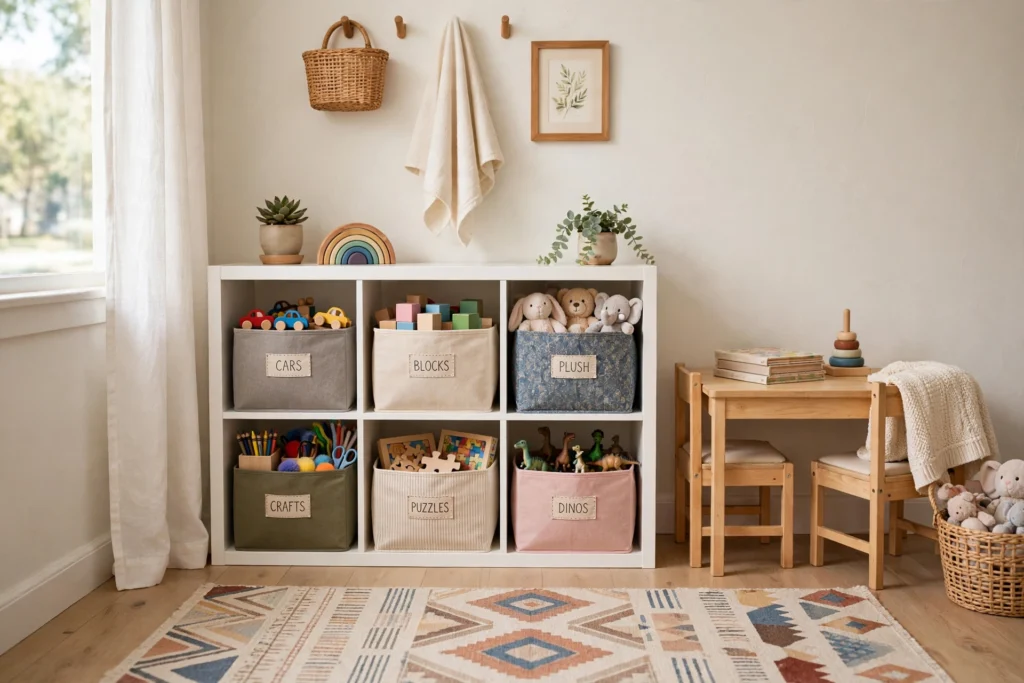
4. Use shallow open bins, not deep toy chests
Deep toy boxes are where toys go to vanish — kids dump them out to find one thing. Shallow, open-front bins on low shelves let kids see everything and put things back without thinking. A set of stackable bins runs about $20–30 and beats a $100 toy chest for actual usability.
5. Label with pictures, not just words
Pre-readers can’t use word labels, so add a photo of the toy category on each bin: blocks, cars, dolls, art supplies. Snap the photos with your phone, print them at home, tape them on. When the cleanup target is a picture, even toddlers can sort.
6. Try the “one bin per category” rule
Each toy category gets exactly one bin. When the bin is full, the category is full — something has to leave before something new arrives. This caps volume automatically and teaches kids natural limits without lectures.
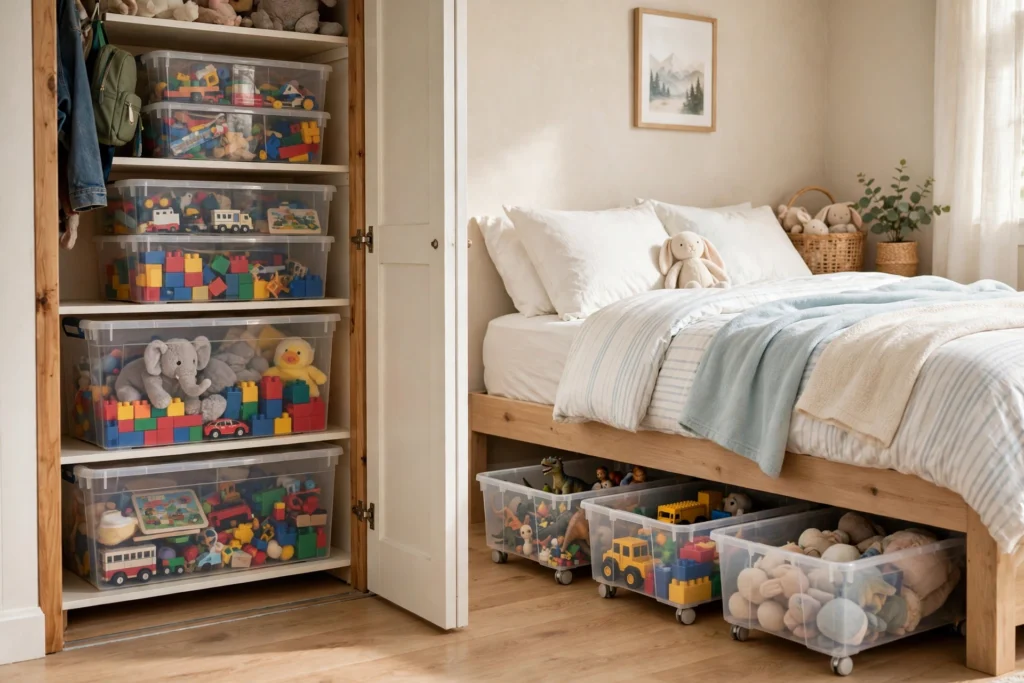
7. Use clear bins for the overflow stash
Rotation bins, seasonal toys, and outgrown-but-saved items should be clear, labeled, and stacked in a closet or under a bed. Clear means you can find the holiday toys in December without opening six containers.
Zone 3: Steal Space — Hidden and Vertical Storage
8. Roll bins under the bed
The under-bed zone is premium real estate in a small room. Low rolling bins ($15–25 each) hold LEGO sets, puzzles, or dress-up clothes and slide out of sight in seconds. If the bed is too low, inexpensive risers add 5–7 inches of clearance — an instant storage upgrade.
9. Use the closet floor and door
A hanging shoe organizer on the closet door holds small toys, craft supplies, and action figures in clear pockets — zero floor space used. The closet floor fits a row of labeled bins for the current rotation. In small bedrooms, the closet is the toy room’s overflow valve.
10. Go up: wall shelves and pegboards
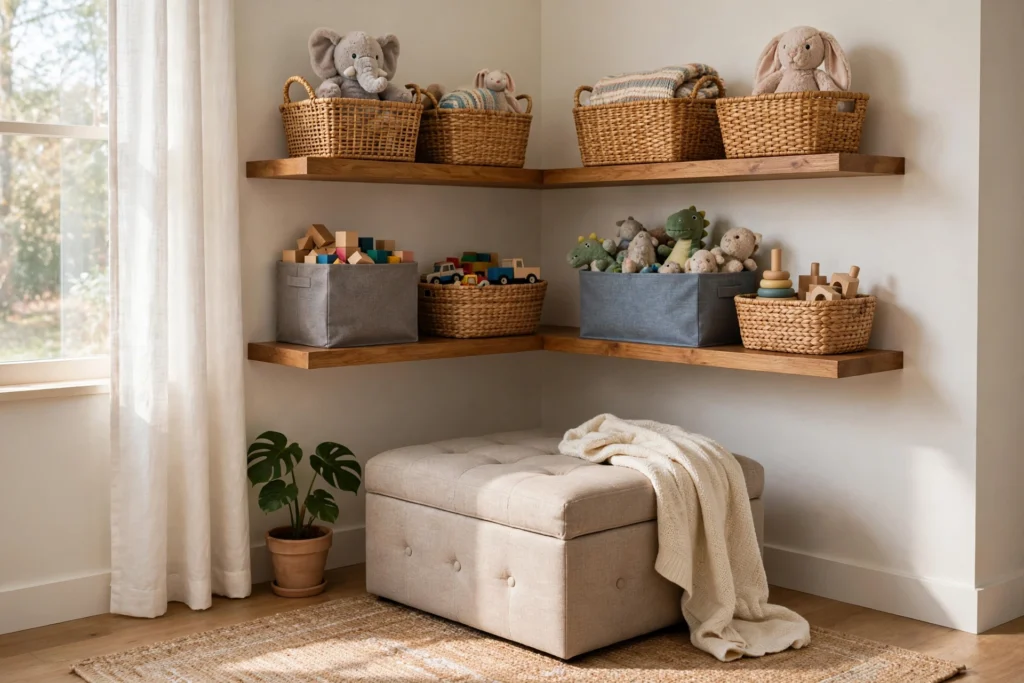
Display-worthy toys (collections, finished LEGO builds) belong on wall shelves, not the floor. A pegboard holds dress-up accessories, headphones, and craft tools. Vertical storage keeps the floor clear for actual playing — which is the point of the room.
11. Choose furniture that stores
In small spaces, every piece of furniture should do double duty: an ottoman with storage inside, a coffee table with shelves, a bench with cubbies by the door. When the play area shares the living room, hidden storage is what keeps it looking like an adult space after bedtime.
Zone 4: Small-Space Layout Tricks
12. Define a play zone with a rug
In a shared living room, a washable rug marks “the toy area” — toys stay on the rug, cleanup means clearing the rug. The boundary is visual, not physical, but kids respect it surprisingly well. Bonus: the rug softens noise for downstairs neighbors.
13. Use a rolling cart as a mobile toy station
A three-tier rolling cart ($25–35) holds the current art supplies, coloring books, and small toys — and rolls into a closet when guests come over. It’s the small-space answer to a playroom: a whole activity center that disappears.
14. Hang a hammock-style net for stuffed animals
Stuffed animals eat floor and shelf space. A corner net hammock (under $15) holds dozens off the ground and doubles as decor. Kids can see and grab their favorites, and the floor stays clear.
15. Mount a fold-down art table
If there’s no room for a permanent craft table, a wall-mounted fold-down table gives kids a work surface that vanishes after art time. Pair it with the rolling cart from #13 and you’ve built a craft station in zero square feet of permanent space.
Zone 5: Systems That Stay Tidy
16. Make cleanup a 5-minute game, not a chore
Set a timer and race the clock, play cleanup music, or sort by color. Five minutes of gamified cleanup beats thirty minutes of nagging — and it works because the toy volume is small enough to clear fast. That’s why decluttering (#1) comes first.
17. Give every toy a home (and enforce it)
“Put it away” fails when “away” is vague. Every toy needs one specific spot — the red bin, the second shelf, the drawer. When cleanup has a destination, kids do it; when it’s abstract, they don’t. Walk the room once and assign homes together.
18. Do a weekly 10-minute toy reset
Once a week, spend ten minutes together: strays go home, broken pieces get tossed, the rotation bin gets a glance. Ten minutes prevents the slow creep that turns “organized” back into “chaos” by Friday.
19. Keep a donation bag in the closet
When a toy breaks, gets outgrown, or stops being played with, it goes straight into the donation bag — not back on the shelf. When the bag is full, it leaves the house. This keeps the one-in-one-out rule (#3) running on autopilot.
20. Store board games vertically like books
Stacked board games topple and get ignored. Stored vertically on a shelf, spine-out like books, each game is visible and grabbable — and kids actually play them. A $10 shelf insert or bookend set does the trick.
21. Photograph LEGO builds, then break them down
Finished LEGO creations are precious — and enormous. Take a photo for the memory book, then dismantle and return the bricks to the bin. Kids keep the pride, you keep the shelf space. Everyone wins.
Quick-Start Plan: If You Only Do 5 Things
- Do the toy audit and donate the excess (#1)
- Start a two-bin rotation (#2)
- Switch to shallow labeled bins with picture labels (#4, #5)
- Roll bins under the bed (#8)
- Make cleanup a 5-minute game (#16)
These five take one weekend and make a small space feel twice as big.
Related reading: apply the same small-space thinking to the rest of the house — these small bedroom organization ideas work for kids’ rooms too, and under-bed storage ideas cover the whole home. If toys have taken over the shared living area, start with small living room organization.
Save this for later
Pin this image to your Pinterest board so it’s there when you need it.
Good to know: Tall toy shelves and cube units should be anchored to the wall. The CPSC’s Anchor It! campaign shows how to fit an anti-tip kit in minutes.
Toy Organization Ideas for Small Spaces FAQ
How do you organize toys in a very small apartment?
Declutter first, then use a rotation system so only half the toys are out at once. Store the rest in labeled bins in closets or under beds, use vertical wall storage, and keep cleanup to a 5-minute daily game.
What is the best toy storage for small spaces?
Shallow open bins on low shelves with picture labels — kids can see everything and put things back independently. Avoid deep toy chests, which become dumping grounds in small rooms.
How often should you rotate kids’ toys?
Every two to three weeks is the sweet spot. It keeps toys feeling fresh, reduces the number out at once, and makes your small space dramatically easier to keep tidy.
How do I get my kids to clean up their toys?
Give every toy a specific home, label bins with pictures, and turn cleanup into a timed game. Kids resist vague instructions (“clean up”) but follow concrete ones (“cars go in the blue bin”).
Stay tidy for good: grab our free Toy Rotation Planner Printable — a one-page sheet to track which toys are out, which are stored, and when to swap, so small-space toy chaos never comes back.
Pingback: 21 Nightstand Organization Ideas for Calmer Mornings