
You don’t need a spare bedroom to have a real home office. Plenty of remote workers do their best work from a corner of the living room, a converted closet, or a 4-foot stretch of hallway wall. What matters isn’t square footage — it’s that everything has a place and your workday has a clear on/off switch. These small home office organization ideas help you get both.
⏱️ Short on time?
Grab our FREE printable checklists — the exact routines behind every calm home on this blog:
📋 Room-by-Room Checklist (PDF)📅 Weekly Reset Checklist (PDF)
Part of our Decluttering & Small Space Organizing Guide, which brings every related post together in one place.
These 20 ideas are built for small spaces: apartments, shared rooms, and those awkward corners you’re not sure what to do with. Most cost under $50, and none of them require a renovation.

Small Home Office Organization Ideas: What You’ll Learn
- 6 desk setups that fit anywhere (ideas 1–6)
- 5 ways to use your walls for storage (ideas 7–11)
- 5 tiny-corner and closet office ideas (ideas 12–16)
- 4 daily systems that keep it all working (ideas 17–20)
- A printable checklist to set up your space
Desk Setups That Fit Anywhere
The desk is the heart of the office. In a small space, it needs to be compact, hardworking, and ideally able to disappear.
1. A Wall-Mounted Drop-Leaf Desk
A 32 x 20 inch drop-leaf desk mounts to the wall and folds flat when the workday ends — your office literally disappears, which is priceless when your “office” is also your dining room. Solid options run $50–$90. Look for one rated to at least 30 pounds so it holds a laptop, monitor, and coffee without wobbling.
Concrete tip: Mount into studs, not drywall anchors. A desk pulling away from the wall mid-Zoom-call is a story you don’t want to live.
2. A Narrow Console Desk (12–16 Inches Deep)
Standard desks are 24–30 inches deep, which is overkill if you work on a laptop. A 12–16 inch deep console desk ($40–$80) fits in hallways, behind sofas, and in bedroom corners that can’t swallow a real desk. Pair it with a monitor arm (idea 5) and you reclaim even more of that shallow surface.
Concrete tip: Measure your laptop open (most are 9–10 inches deep) plus 4 inches for a notebook. If it fits, the desk is deep enough.
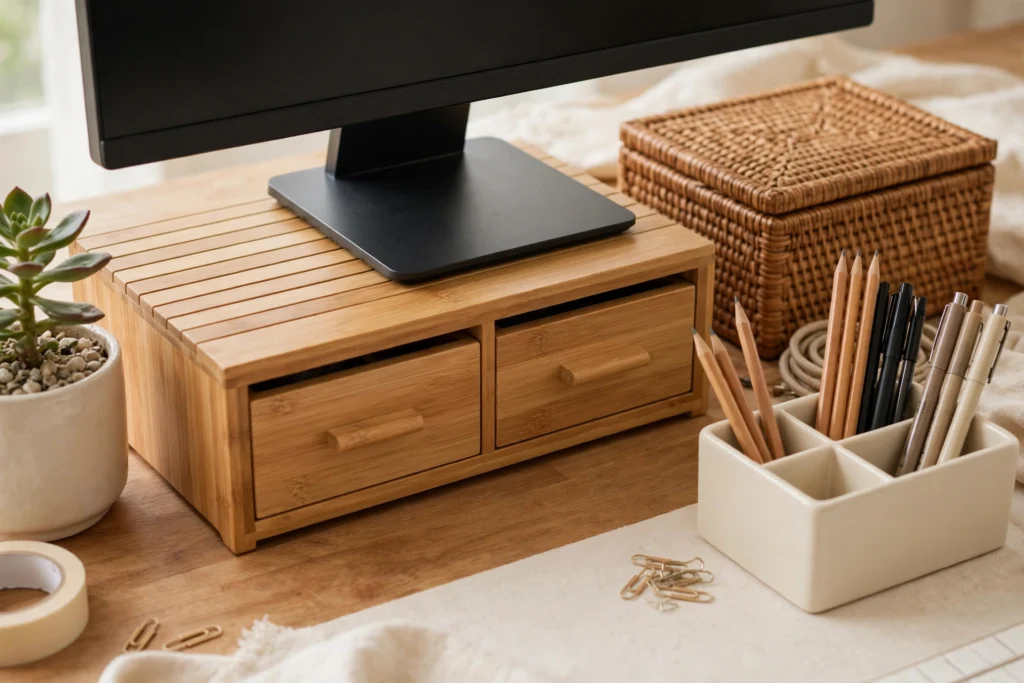
3. A Monitor Riser With Built-In Drawers
A $25–$40 bamboo or wood monitor riser lifts your screen to eye level — which your neck will thank you for — and the drawers or cubbies underneath swallow pens, sticky notes, USB drives, and the chapstick collection. It’s the cheapest ergonomic upgrade that exists, and it manufactures storage out of thin air.
Concrete tip: Your eye level should hit the top third of the screen. Stack books under the riser temporarily to find your height before you buy.
4. An Under-Desk Rolling Drawer Unit
A 3-drawer rolling unit ($30–$55) slides under any desk and holds files, chargers, notebooks, and office supplies. The rolling part matters: pull it out to access, push it back to reclaim legroom. Get one with a flat top and it doubles as a printer stand or extra surface.
Concrete tip: Dedicate one drawer to “cables and tech” with small dividers. Loose cables in a drawer become a tangled nest within a week — dividers are the $5 fix.
5. A Monitor Arm to Free the Desktop
A single monitor arm ($25–$45) clamps to the back of your desk and holds your screen floating above the surface. You instantly gain the entire footprint the monitor stand was eating — roughly a square foot — plus you can swing the screen aside when you need the full desk. Most arms fit desks up to 3 inches thick and screens up to 32 inches.
Concrete tip: Check your monitor has VESA mounting holes on the back (most do — 75x75mm or 100x100mm). A tiny fraction of budget monitors don’t, so verify before ordering.
6. A Laptop Stand + External Keyboard
If you work from a laptop, a $20–$30 aluminum stand raises the screen to eye level and an external keyboard ($25–$50) lets your hands rest naturally. This $50 combo prevents the hunched “laptop neck” that plagues remote workers, and when the day ends, the laptop closes and slides into a drawer — desk instantly clear.
Concrete tip: This is also the fastest “office to dining table” conversion there is. Stand folds flat, keyboard goes in a drawer, and nobody knows you worked there.
Walls: Your Free Square Footage
When floor space is precious, build up.
7. Floating Shelves Above the Desk
Two 24-inch floating shelves ($15–$25 each) mounted 16–20 inches above your desk hold books, reference binders, a small plant, and pretty storage boxes — keeping all of it off your work surface. The golden rule: nothing on the shelves that you need daily. Daily-use items live on the desk; shelves are for weekly-or-less.
Concrete tip: Keep shelf decor minimal and work-related. A shelf crammed with knickknacks above your desk is visual noise you’ll stare at for 8 hours a day.
8. A Pegboard Command Center
A 22 x 22 inch pegboard ($15–$25 plus $10–$15 for hooks and cups) turns dead wall into endlessly rearrangeable storage: hanging file holders, pen cups, small shelves, headphone hooks, even a tiny clock. When your needs change, you move hooks instead of buying new furniture. Paint it to match your wall color for a built-in look, or leave the wood natural for warmth.
Concrete tip: Trace your most-used items’ outlines on paper first and arrange on the floor. You’ll use 30% fewer hooks when you plan the layout instead of improvising.
9. Wall-Mounted File Holders
Three stackable wall file trays ($18–$28) beside your desk create an inbox system without sacrificing a single inch of desk: top tray for incoming, middle for in-progress, bottom for outgoing. It takes 10 minutes to mount and ends the “pile on the desk corner” era permanently.
Concrete tip: Label the trays with a label maker or neat handwriting. Unlabeled trays become mystery piles within a month — the labels are the system.
10. A Magnetic Board for Notes and Inspiration
A 24 x 18 inch magnetic board ($20–$35) holds your to-do list, deadlines, and the occasional inspiring quote without a single pin hole in the wall (most mount with adhesive strips). Unlike a corkboard, it looks clean and modern, and rearranging is silent and instant.
Concrete tip: Limit it to 5–7 items. A board covered edge-to-edge stops being a focus tool and becomes wallpaper you stop seeing.
11. Over-Door Organizer on the Office Door
A clear over-the-door organizer ($10–$15) on your office or closet door adds 20+ pockets for supplies, mail, tech accessories, and reference materials. It’s completely renter-friendly and invisible when the door is open. This is where the “I might need this someday” stuff lives instead of your desk drawers.
Concrete tip: Put a small label at the top of each column (“Mail,” “Tech,” “Supplies”). Future you, hunting for a stamp in a hurry, says thanks.
Tiny Corners and Closet Offices
No spare room? No problem. These ideas manufacture an office out of spaces you’re not using.
12. The Cloffice (Closet Office)
A standard reach-in closet is about 24 inches deep — which is exactly desk depth. Remove the doors (store them, don’t toss them if you rent), install a 20-inch-deep countertop or shelf board at 29–30 inches high ($30–$60 for the board plus brackets), add a task light, and you have a full office that closes away behind a curtain. Add shelves above for storage. Total cost: usually under $100.
Concrete tip: Hang a curtain instead of reinstalling doors. It softens the look, costs $15, and the “closing the curtain at 5pm” ritual is a surprisingly powerful work-life boundary.
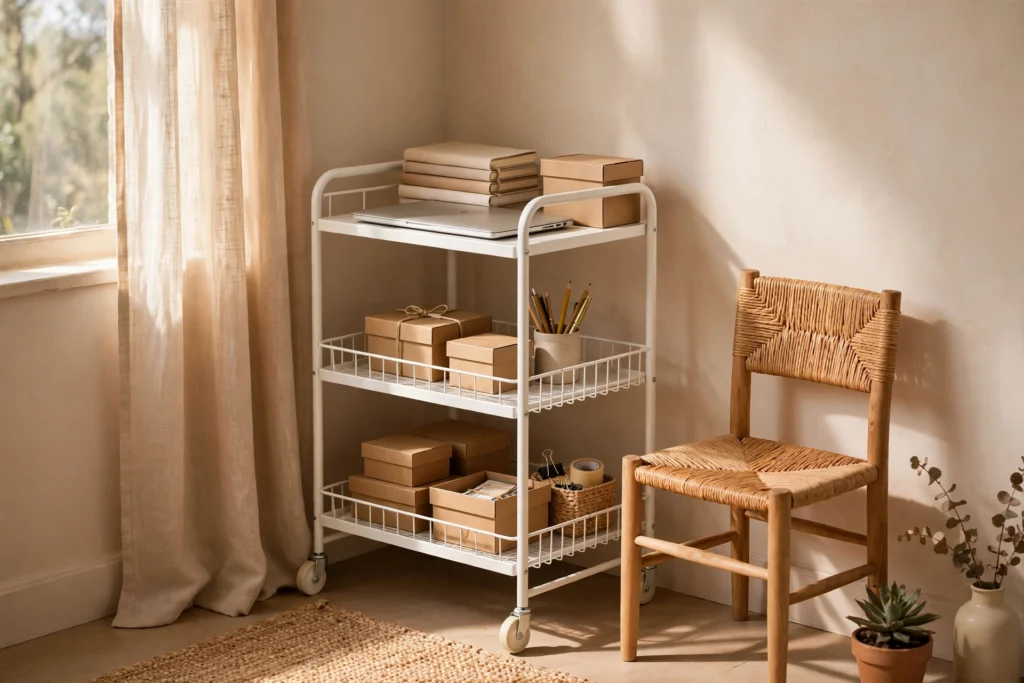
13. A Rolling Cart Office
A 3-tier rolling cart ($25–$40) holds your laptop, notebook, chargers, and supplies — and rolls into a closet when the day ends. This is the ultimate small-space office for people whose “desk” needs to be the kitchen table at noon and gone by dinner. Keep the cart stocked and ready; the 30-second setup is the whole point.
Concrete tip: Use the top tier for active work only. Middle tier is supplies, bottom tier is files and reference. When tiers have jobs, the cart stays organized on its own.
14. The Corner Desk Squeeze
Two walls meeting in a corner is free desk support. A corner desk ($60–$120) or even two wall-mounted shelf boards forming an L gives you a surprisingly generous work surface in about 4 square feet of floor space. The L-shape is genuinely ergonomic — monitor on one arm, notebook and coffee on the other.
Concrete tip: Put your monitor in the actual corner, angled toward you. It feels counterintuitive, but it centers your focal point and leaves both wings free.
15. Under-Stair Nook Office
That awkward space under the stairs (usually 3–4 feet of headroom at the low end, opening up as you go in) fits a small desk and chair perfectly. Add a $15 stick-on LED light strip under the stair above, a power strip, and suddenly the weirdest corner of the house is the coziest office in it. Measure first: you need at least 30 inches of width and enough height to sit upright.
Concrete tip: A small rug defines the space and dampens sound. Under-stair nooks echo, and a $20 rug fixes it.
16. A Fold-Down Secretary Desk
A vintage-style secretary desk ($80–$150 secondhand, often less at thrift stores) has a drop-down writing surface and cubbies inside the top. Open it to work, close it to hide everything — it looks like a decorative cabinet when shut. These are everywhere on Facebook Marketplace because everyone’s grandmother had one.
Concrete tip: Check the drop-down surface is at least 28 inches high and the hinges are solid. A wobbly writing surface ruins the whole concept.

Daily Systems That Keep It Working
An organized office isn’t a one-time project — it’s four small habits.
17. The 5-Minute End-of-Day Reset
Before you log off, spend 5 minutes: file or toss every paper on the desk, return pens to their cup, plug in devices at the charging station, and wipe the desk. Tomorrow morning you sit down to a clean slate instead of yesterday’s mess, which genuinely changes how the workday starts. Set a daily alarm for 4:55pm until it’s automatic — about 3 weeks.
Concrete tip: Include “close all browser tabs” in the reset. A clean physical desk with 47 open tabs is only half a reset.
18. One Charging Station, Zero Cable Sprawl
Designate one spot — a small tray or box ($12–$20) on or near the desk — where every device charges. Run a single power strip to it and use short 1-foot cables instead of 6-foot ones tangling everywhere. Label each cable with a bread-clip tag or washi tape. Cable sprawl is the #1 thing that makes small offices look chaotic, and this fixes it for under $20.
Concrete tip: Count your devices and buy a strip with 2 more outlets than you need. There is always one more device.
19. The One-Inbox Rule
All incoming paper — mail, school forms, receipts — goes in ONE inbox tray, never on the desk surface. Process the inbox twice a week (15 minutes): toss, file, or act. Anything that sits longer than a week gets a decision forced on it. This single rule prevents 90% of desk clutter, because desk clutter is almost always unprocessed inbox in disguise.
Concrete tip: Put the inbox tray somewhere slightly inconvenient — a shelf, not the desk. If it’s too handy, you’ll “quickly check” it 20 times a day instead of processing it twice a week.
20. A “Work Hours” Signal for Shared Spaces
If your office is in a shared room, you need a signal that you’re working: headphones on, a small “in a meeting” sign on the desk ($8), or a specific lamp that’s only on during work hours. It trains the household faster than any conversation. Pair it with the curtain-close or laptop-away ritual from ideas 12 and 6, and your brain starts associating the signal with focus — which is the real productivity hack.
Concrete tip: Agree on the signal’s meaning once, out loud, with everyone. “Headphones on means knock first” only works if it’s been said, not just thought.
Your Small Home Office Checklist
Set up your space in a weekend with this list:
- ☐ Measure your space (width, depth, and outlet locations)
- ☐ Choose your desk type: drop-leaf, console, cloffice, or cart
- ☐ Get your screen to eye level (riser, arm, or laptop stand)
- ☐ Tame cables: one charging station, short cables, labeled
- ☐ Add wall storage: shelves, pegboard, or file holders
- ☐ Set up the inbox tray and label it
- ☐ Create your end-of-day reset alarm (5 minutes)
- ☐ Establish your “work hours” signal with the household
- ☐ Add one personal touch: a plant, a photo, a candle
- ☐ Work one full day, then adjust what annoyed you
Grab the Free Printables
Our free weekly reset checklist includes a 5-minute desk reset routine — perfect for idea #17. Get the free printables here.
Keep Reading
- Small Bedroom Organization Ideas — when your office shares space with your bedroom
- Rental-Friendly Organization Ideas — every idea above that doesn’t damage walls
- Weekly Reset Routine — the Sunday reset that keeps the whole house (office included) calm
- Craft Room Organization Ideas
Save this for later
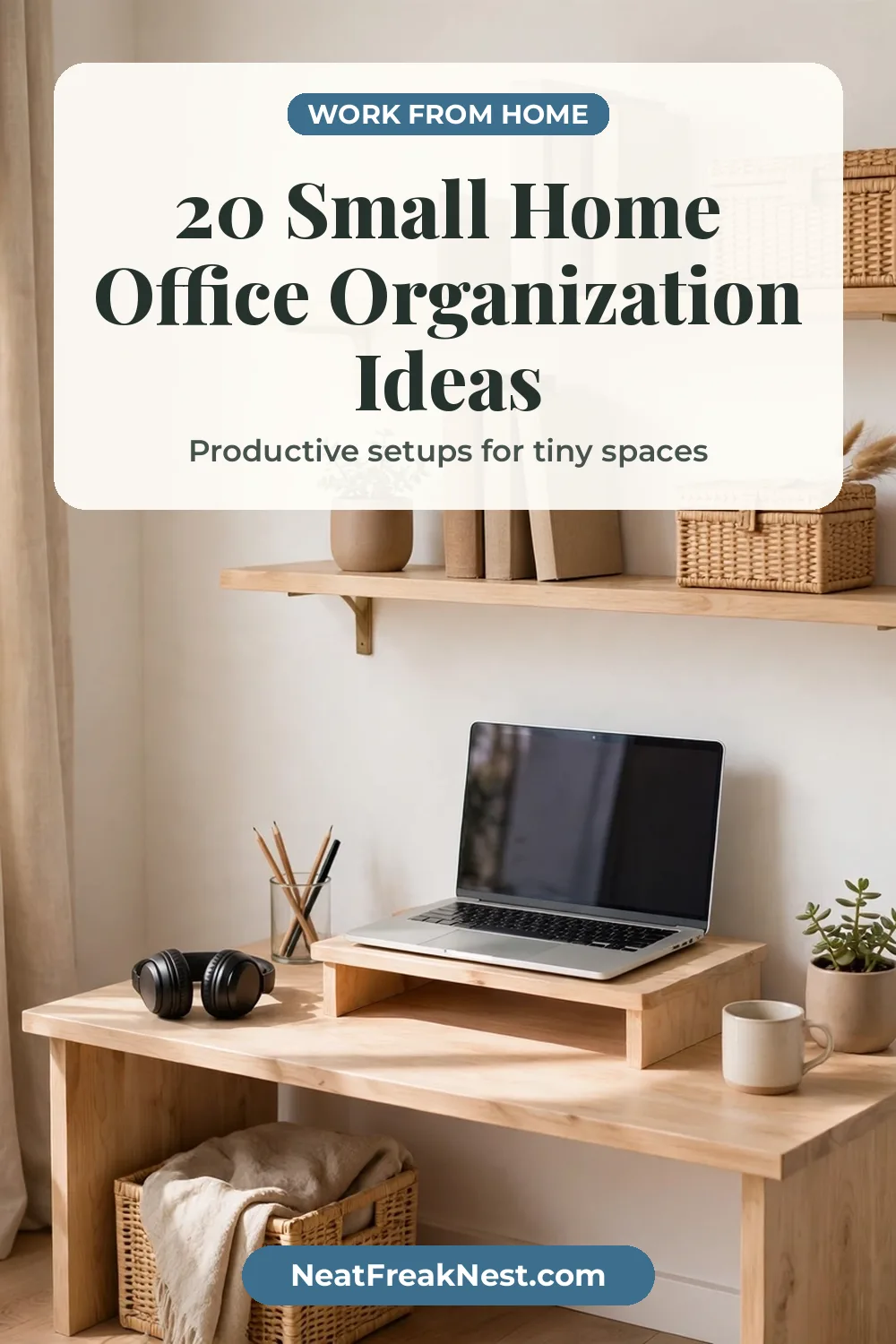
Pin this image to your Pinterest board so it’s there when you need it.
 Save to Pinterest
Keep going: pair this guide with our 30-day decluttering checklist and entryway organization ideas.