
You open the freez
Part of our Kitchen Cleaning & Organization Guide, which brings every related post together in one place.
⏱️ Short on time?
Grab our FREE printable checklists — the exact routines behind every calm home on this blog:
📋 Room-by-Room Checklist (PDF)📅 Weekly Reset Checklist (PDF)
It’s not the freezer’s fault. Freezers don’t get messy because they’re broken — they get messy because there’s no system. And unlike the fridge, where everything sits in plain sight, the freezer hides its chaos behind frost and a closed door. That’s exactly why freezer organizing needs its own playbook: bins with jobs, the flat-freeze filing method, a rotation rule, and an inventory list you’ll actually keep up.
Below are 17 freezer organization ideas for chest, upright, and tiny apartment freezers. Start wherever your freezer frustrates you most — one afternoon of work and you’ll see everything you own and actually use it.
What to Buy Before You Start (Under $40 Total)
If you’re starting from zero, this is the complete kit behind all 17 ideas:
- Open-top bins with handles, 4-pack — about $15 at Target or Walmart. These are the backbone of the whole system.
- Freezer tape and a permanent marker — about $5. Labels are the difference between a system and a pile.
- Small magnetic whiteboard — about $6. Stick it on the freezer door for your inventory list.
- Reusable silicone freezer bags, set of 6 — about $12. The flat-freeze workhorses.
- Stackable wire baskets — about $8 each. Optional but transformative for tiny freezers.
All in: roughly $30–40 for everything, or under $20 if you start with just bins, tape, and a marker. Want the fridge to match when you’re done? Our aesthetic fridge organization guide uses the same bins-and-zones system.
Win the Chest Freezer
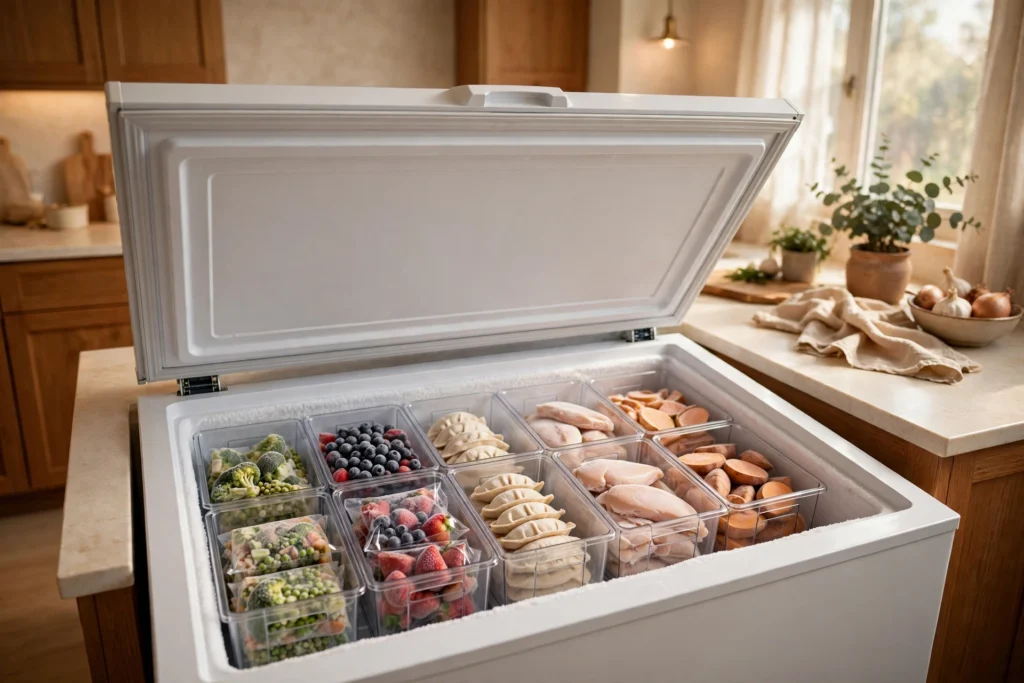
Chest freezers hold the most but hide everything. Without bins, a chest freezer is just a cold pit where food goes to be forgotten. Bins fix that.
1. Give every category its own bin
Meats, veggies, bread, frozen fruit, breakfast items — one open-top bin each, clear or wire so you can see through them. With a category per bin, you never dig: you just lift the right one.
2. Choose bins with handles, not lids
Chest freezer lids are cold, stiff, and annoying. Open-top bins with handles let you lift a whole category onto the counter while you shop. Measure the opening before you buy — some wide bins won’t fit through the door.
3. Stand bags upright with dividers
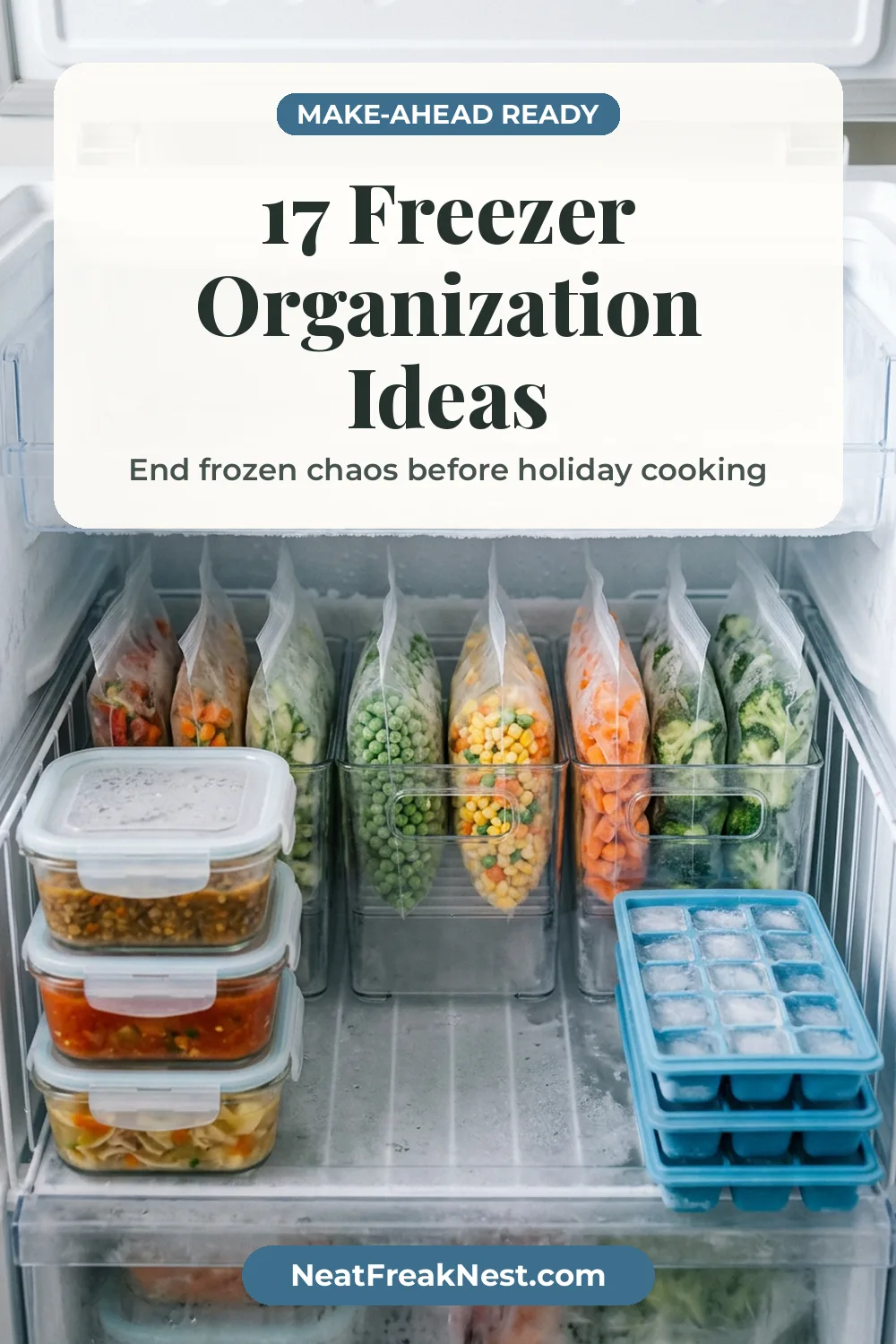
Think magazine files, but cold. Slide vertical dividers between bags of frozen vegetables and berries so they stand upright instead of lying in a pile. Flip through them like folders and grab exactly the bag you want.
4. Freeze flat first, then file like folders
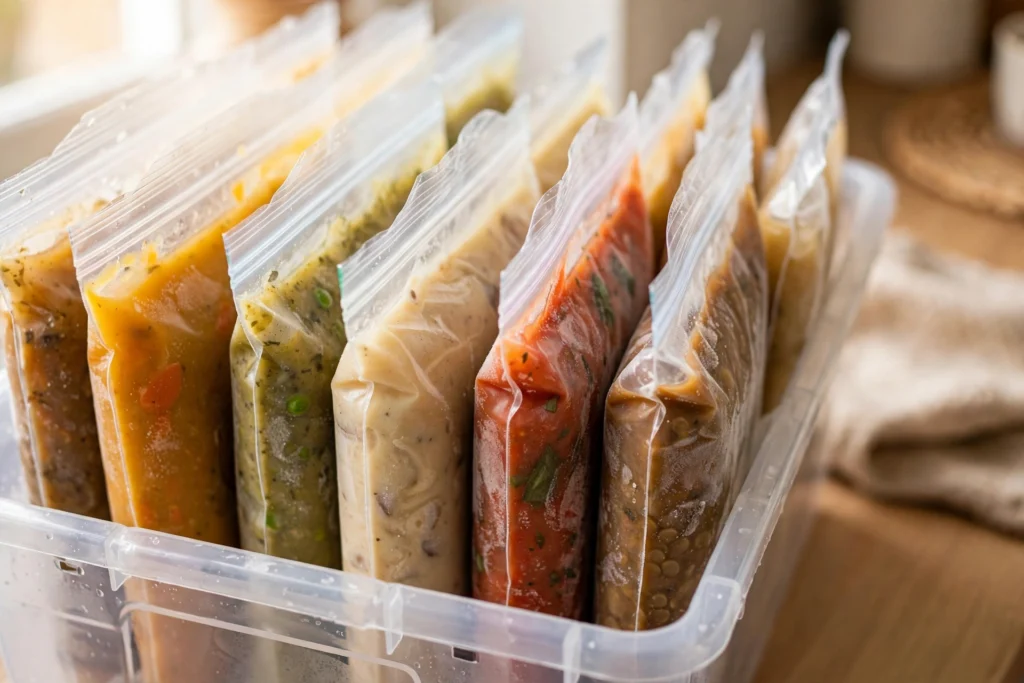
This is the single biggest space saver in any freezer. Pour soup, sauce, chili, or ground meat into a freezer bag, press it flat, squeeze out the air, and lay it on a sheet pan to freeze. Once frozen solid, stand the flat bags upright in a bin like file folders. Flat-frozen bags take up roughly half the space of lumpy ones and you can read every label at a glance.
Tame the Upright Freezer
Upright freezers are easier to see into but their shallow shelves waste space fast. Zones make every inch count.
5. Assign every shelf and door bin a job
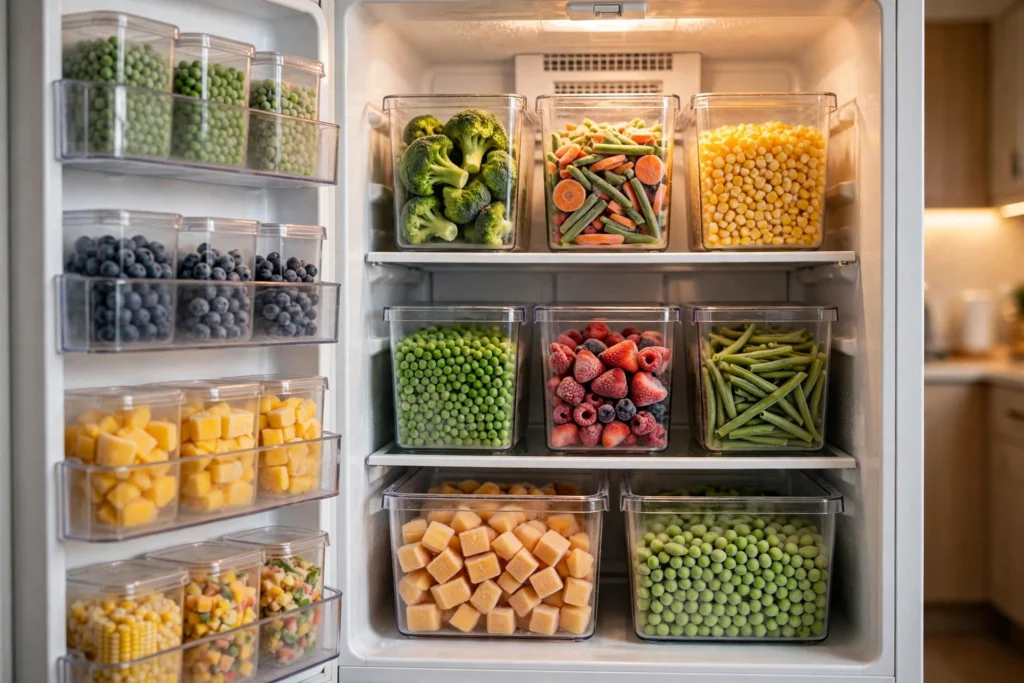
Top shelf: breakfast items. Middle: meal prep and leftovers. Bottom: raw meat on a rimmed tray — the coldest spot. Door bins: small grabbable items. Once every shelf has a job, putting groceries away takes two minutes and everyone can do it.
6. Add slim bins to shallow shelves
Slim bins around 3–4 inches wide turn each shallow shelf into tidy lanes: vegetables, fruit, meat. Measure shelf depth first — bins that are too tall keep the door from closing.
7. Corral the small stuff in the door
Frozen fruit cups, cheese sticks, ice packs, and half-used bags of peas all migrate to the back of shelves. Give them a home in the door bins instead — one for snacks, one for small add-ins.
Systems That Work in Any Freezer
Bins and zones are the hardware. These five habits are the software that keeps them working.
8. Label and date everything
Freezer tape and a permanent marker — masking tape falls off and regular ink fades in the cold. Write three things: what’s inside, the date, and how much (“2 cups chili, Oct 23”). Future you will be grateful.
9. Rotate first-in, first-out (FIFO)
Grocery-store rule, home-freezer gold. New items go in the back or the bottom; oldest items move to the front. Take ten seconds when unloading groceries to move older bags forward. This one habit cuts freezer waste more than anything else here.
10. Keep a freezer inventory on the door or your phone
Stick a small magnetic whiteboard on the freezer door and list what’s inside by category — or keep a shared phone note. Either way, you stop buying your fourth bag of frozen shrimp because you can see you already have three.
11. Build batch meal-prep zones
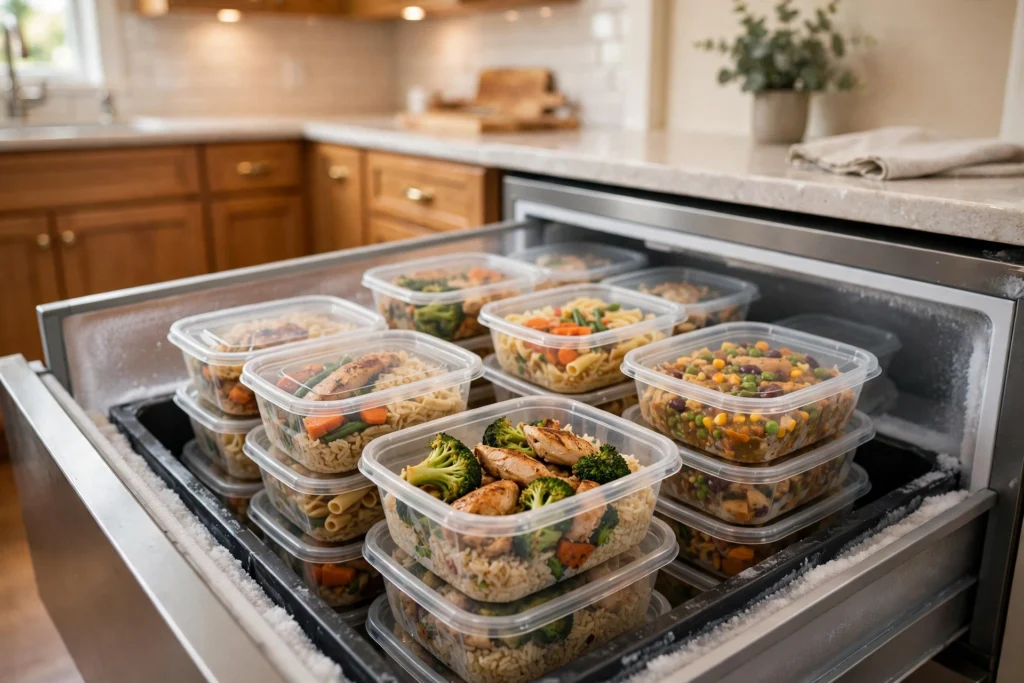
Dedicate one bin to ready-to-eat meals (soups, casseroles, cooked grains) and one to meal kits — a recipe’s raw ingredients bagged together. On busy nights you grab a meal, not a scavenger hunt. Use matching stackable containers so the bin stays neat.
12. Stock a holiday-baking stash zone
Dedicate one bin to baking: extra butter, pie crusts, cookie dough scoops frozen on a sheet pan, chocolate chips, chopped nuts. With Thanksgiving about five weeks out, this one pays off fast — and everything’s in one place when the baking urge hits. Pair it with our holiday baking prep routine to plan what to stock.
Small-Freezer and Apartment Tricks
Renters and apartment dwellers usually get the tiny freezer on top of the fridge. The same system works — just at a smaller scale.
13. Add stackable wire baskets to a tiny top freezer
That little freezer compartment wastes all its vertical space. One or two small stackable wire baskets create a second level: daily items on top, bulk items below. Measure the compartment first — most top freezers fit 6-inch baskets perfectly.
14. Portion everything before you freeze
Single servings stack tighter and thaw faster than one giant block. Freeze soup in 1-cup portions, ground meat in half-pound flats, cookie dough as scoops — so you only thaw what you’ll eat that day.
15. Keep a “use me soon” bag for stragglers
Half a bag of peas, two lone meatballs, the opened box of corn — stragglers clutter every freezer. Toss them all into one bag or small bin labeled “use me soon” and pull from it first when you cook. It’s the freezer’s answer to an eat-me-first bin.
Keep It That Way
Organization without maintenance lasts about a month. Two habits make it stick.
16. Defrost and wipe down once or twice a year
If frost builds up thicker than a quarter inch, your freezer is working harder than it needs to. Once or twice a year, move food to coolers, unplug, let it melt, and wipe the inside with a damp cloth — perfect timing to check labels and toss anything past its prime. Do it alongside a refrigerator cleanout and both are done in an hour.
17. Do a 15-minute freezer reset every month
Pick a day — the first Sunday of the month works. Check your inventory list against what’s actually in there, toss anything badly freezer-burned, and return wanderers to their bins. Fifteen minutes, timer on. That’s the entire maintenance system.
Your Freezer Organization Checklist
- Category bins for the chest freezer
- Open-top bins with handles
- Vertical dividers for standing bags upright
- Freezer bags frozen flat, filed like folders
- Shelf and door-bin zones assigned
- Slim bins on shallow shelves
- Small items corralled in the door
- Everything labeled and dated
- FIFO rotation when unloading groceries
- Inventory list on the door or phone
- Batch meal-prep zones
- Holiday-baking stash zone
- Stackable baskets for small freezers
- Single-serving portions
- “Use me soon” bag for stragglers
- Annual defrost and wipe-down
- Monthly 15-minute freezer reset
Save this for later
Pin this image to your Pinterest board so it’s there when you need it.
 Save to Pinterest
Good to know: Frozen food stays safe at 0°F, but quality fades over time. The USDA’s freezing and food safety guide has a month-by-month freezer storage chart.
Sources & safety notes
The safety and care points in this guide are based on these public sources. Your appliance manual and product labels always come first, so follow them where they differ from general advice.
- Freezing and Food Safety (USDA Food Safety and Inspection Service): food kept at 0°F stays safe indefinitely, and its freezer storage chart gives quality guidelines in months for meats, casseroles, soups and more.
- Refrigeration & Food Safety (USDA Food Safety and Inspection Service): explains how temperature, placement and a clean refrigerator-freezer keep stored food safe.
Freezer organization ideas FAQ
How long can food stay in the freezer?
Frozen food stays safe as long as it stayed frozen, but quality declines over time. Most meats taste best within 3–4 months; fruits and vegetables hold up for 8–12 months. That’s why the label-and-date system matters — eat the oldest first.
What temperature should my freezer be?
Keep it at 0°F. At that temperature, food quality holds much longer than in a too-warm freezer. If you’re not sure where yours stands, a $5 freezer thermometer takes ten seconds to read.
What’s the best way to prevent freezer burn?
Freezer burn comes from air: squeeze air out of bags before sealing, wrap in two layers for long-term storage, and use bags or containers made for the freezer — thin sandwich bags don’t protect well.
Can I really organize a tiny apartment freezer?
Yes — shrink the system. One stackable basket, a few freezer bags frozen flat, and strict portions. In a tiny freezer, every inch needs a job, or it turns into a frosty junk drawer within a week.
Start With One Bin and a Marker
You don’t need all 17 ideas to fix your freezer — you need a starting point. Grab one bin, label what’s in it, and freeze your next batch of soup flat. That’s a ten-minute win that changes how the whole freezer feels.
Want a printable version to stick on the freezer door? Grab our free printables — freezer inventory lists, label templates, and the full 17-idea checklist, all ready to download and print.
Pingback: 19 Food Storage Container Organization Ideas