
If your glasses come out cloudy, the door smells a little sour, or there’s grit in the bottom of the tub, your dishwasher needs more than another load. Knowing how to clean a dishwasher with vinegar and baking soda fixes most of those problems for about fifty cents, with no harsh chemicals. The trick most guides skip: the filter comes first, and the vinegar and baking soda go in separate cycles, not mixed together.
⏱️ Short on time?
Grab our FREE printable checklists — the exact routines behind every calm home on this blog:
📋 Room-by-Room Checklist (PDF)📅 Weekly Reset Checklist (PDF)
Part of our Kitchen Cleaning & Organization Guide, which brings every related post together in one place.
This guide walks through the full monthly deep clean (filter, spray arms, seals, then two hot cycles), plus how to fix specific smells, white film, standing water and mold. Plan on about 30 minutes of hands-on work and roughly 2 hours of machine time.
How to Clean a Dishwasher With Vinegar and Baking Soda: What You’ll Learn
- Why the filter matters more than the vinegar
- The 6-step monthly deep clean, with exact amounts
- Why you shouldn’t mix vinegar and baking soda in one cycle
- How to fix rotten-egg smells, cloudy glasses, standing water and mold
- A simple schedule that keeps it clean between deep cleans
Why Dishwashers Get Dirty in the First Place
A dishwasher washes dishes, but it doesn’t wash itself. Every load leaves behind a little food, grease and detergent residue. Most of it gets caught by the filter at the bottom of the tub, and anything the filter misses settles in the door gasket, the lower door edge and the spray arm holes. Add hard water minerals, and you get the classic trio: a musty smell, a gritty or greasy film inside the tub, and dishes that don’t come out as clean as they used to.
Many newer dishwashers use a manual filter you’re meant to clean yourself, instead of the older self-cleaning grinder style. If you’ve never taken yours out, that’s very likely the source of your smell. Vinegar and baking soda are great finishers, but they can’t rinse away a filter packed with food.
What You Need
| Item | Amount | What it does |
|---|---|---|
| Distilled white vinegar (5% acidity) | 1 cup (240 ml) | Dissolves mineral scale and detergent film |
| Baking soda | 1 cup | Deodorizes and gently lifts residue |
| Dish soap | A few drops | Cuts grease on the filter and seals |
| Soft brush or old toothbrush | 1 | Scrubs the filter and gasket folds |
| Toothpick or wooden skewer | 1 | Clears clogged spray arm holes |
| Microfiber cloths | 2 | Wipes seals, door edges and the exterior |
| Dishwasher-safe bowl or 2-cup glass measuring cup | 1 | Holds the vinegar upright on the top rack |
Skip steel wool and abrasive powders inside the tub; they scratch stainless steel and can leave rust spots. Most of these supplies overlap with our natural cleaning recipes, so you probably have everything already.
Step-by-Step: How to Clean a Dishwasher With Vinegar and Baking Soda
Step 1: Empty it and check the bottom
Unload every dish and pull out the bottom rack. Look for anything sitting in the bottom of the tub or around the drain: broken glass, labels from jars, cherry pits, toothpicks. Wear gloves or use a paper towel, since there can be glass in there. If your dishwasher drains through a garbage disposal, run the disposal for a few seconds now so the drain line is clear.
Step 2: Clean the filter
The filter is usually a cylinder in the floor of the tub, under or beside the lower spray arm. On most models you twist the top counterclockwise a quarter turn and lift it out, then lift out the flat mesh plate beneath it. Check your manual if it doesn’t budge; never force it.
Soak both pieces in hot water with a few drops of dish soap for 10 minutes, then scrub gently with a soft brush, inside and out, and rinse under running water until the mesh looks clear when you hold it up to the light. Don’t use a wire brush; a torn mesh lets food reach the pump. Wipe out the filter well (the sump) with a damp cloth before you put everything back, and make sure it locks into place.
Step 3: Clear the spray arms
Spin each spray arm by hand. If it catches or wobbles, something is in the way. Most lower arms lift straight off, and most upper arms unscrew or unclip. Hold each arm up to the light: any hole you can’t see through is clogged. Poke the debris out with a toothpick, then rinse the arm under the tap and shake out what’s inside.
Step 4: Wipe the gasket, door edge and dispenser
Mix equal parts vinegar and warm water in a small bowl. Dip a cloth or toothbrush in it and work around the rubber door gasket, getting into the folds. Then open the door wide and wipe the bottom edge of the door and the strip of tub below it. That area sits outside the spray pattern, so it never gets washed and it’s where a lot of the smell lives. Finish with the detergent dispenser, the rinse aid cap and the control panel edge.
Step 5: Run a hot vinegar cycle
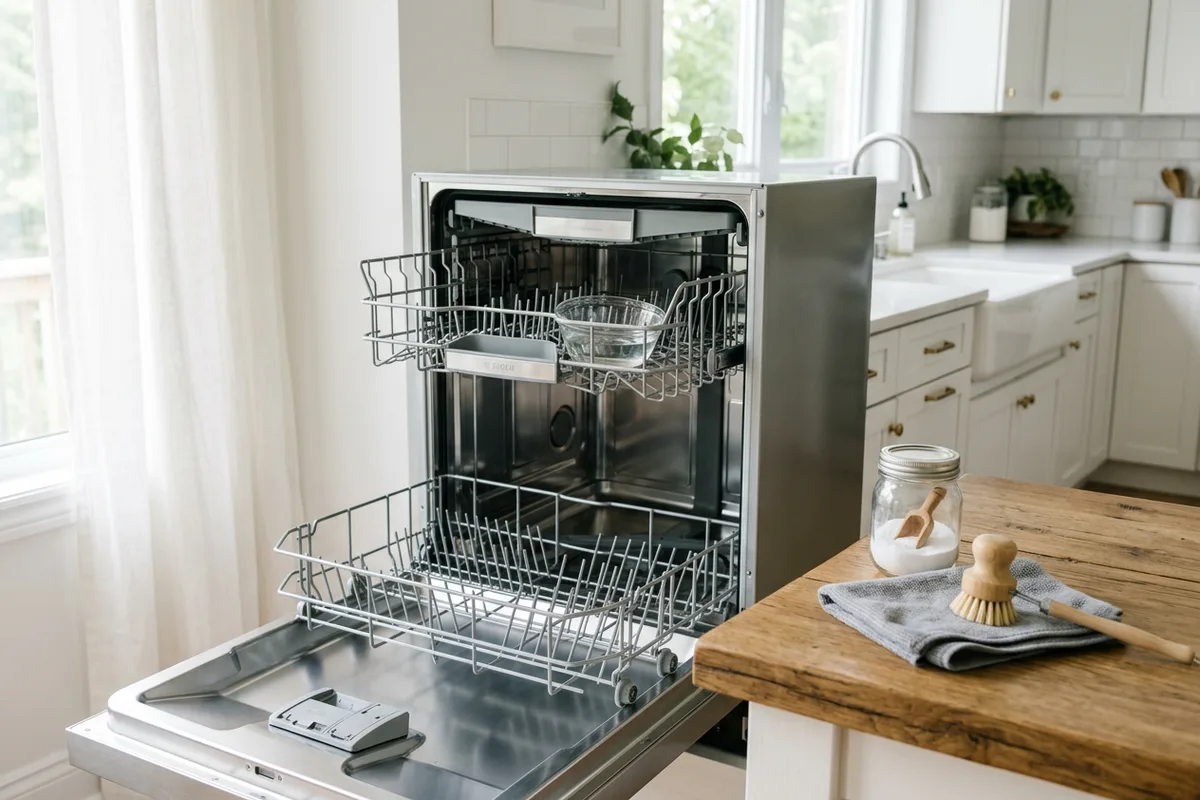
Put the racks back. Run your kitchen faucet until the water comes out hot, so the dishwasher’s first fill starts hot. Set a dishwasher-safe bowl or a 2-cup glass measuring cup on the top rack, upright, and fill it with 1 cup of white vinegar. Run the hottest full cycle your machine has (often “Pots & Pans”, “Heavy” or “Sanitize”) with no detergent and no dishes. The bowl tips its vinegar into the wash water as the cycle runs, dissolving mineral scale and greasy detergent film.
Step 6: Finish with a baking soda cycle
When the vinegar cycle ends, sprinkle 1 cup of baking soda evenly across the bottom of the tub. Run a short hot cycle, such as “Rinse” or “Quick”. The baking soda deodorizes and buffs away stains, leaving the stainless brighter. For a strong smell, sprinkle the baking soda and leave it overnight with the door closed, then run the short cycle in the morning.
Finally, leave the door cracked open for an hour so the tub dries completely. Moisture is what lets odors and mildew come back.
Why Not Mix Vinegar and Baking Soda Together?
The fizz looks impressive, but it’s the two cancelling each other out. Vinegar is an acid and baking soda is a base; together they turn into mostly water, carbon dioxide and a little sodium acetate within seconds. Used in separate cycles, each one does its own job: vinegar breaks down mineral scale and film, then baking soda deodorizes and polishes. That’s why the order matters, and why both cleaning steps get their own cycle.
Safety Notes Before You Start
- Never combine vinegar or any acid with bleach. The mix releases chlorine gas. If you’ve used a bleach product in the dishwasher, run a plain hot rinse cycle before using vinegar, and use them on different days.
- Check your manual. Some manufacturers advise against frequent vinegar use because acid may wear rubber seals over time. Once a month is plenty; there’s no benefit to adding vinegar to every load.
- Use white vinegar only. Apple cider vinegar and other flavored vinegars can leave a smell and stains.
- Don’t put the vinegar in the detergent cup. It releases in the main wash only and can be too concentrated on the dispenser seal.
Troubleshooting: Smells, Film, Standing Water and Mold
Rotten-egg or garbage smell
This is almost always trapped food in the filter or sump. Clean the filter (Step 2), then do the overnight baking soda option. Scrape plates before loading and run the dishwasher at least every couple of days so food doesn’t sit.
Sewage smell
A sewer-like smell often points to the drain hose. Under the sink, it should rise in a “high loop” or connect to an air gap so dirty sink water can’t flow back into the dishwasher. If you have an air gap (the small cap beside the faucet), pull the cover off and clear any gunk. If the smell continues, call a plumber or appliance technician.
Burning plastic smell
Stop the cycle and check the heating element in the tub floor for a fallen lid or utensil. If nothing is there, or you smell something electrical, turn off power at the breaker and call a technician. Don’t keep running it.
Cloudy glasses and white film
Try this test: soak a cloudy glass in white vinegar for 5 minutes. If it clears, the film is hard water minerals, and the vinegar cycle plus a rinse aid will help. Check whether your model has a water softener or hardness setting and adjust it. If the glass stays cloudy, it’s etching, which is permanent; use less detergent and avoid very hot drying on delicate glasses. As an alternative to vinegar, about 2 tablespoons of food-grade citric acid in the detergent cup on an empty hot cycle also removes heavy scale.
Standing water in the bottom
A small amount of water around the filter can be normal. An inch or more is not. Clean the filter, run the garbage disposal, check that the drain hose under the sink isn’t kinked, and clear the air gap.
Mold or black spots on the gasket
Scrub with warm water and dish soap and a toothbrush, then wipe with 3% hydrogen peroxide, leave it 10 minutes and rinse. Avoid bleach in stainless steel tubs, which it can pit, and only use it at all if your manual allows it. Prop the door open after every cycle for a week to dry things out.
How Often to Clean Your Dishwasher
| Task | How often |
|---|---|
| Scrape plates and check for debris in the tub | Every load |
| Wipe gasket and lower door edge | Weekly |
| Clean the filter | Monthly (every 2 weeks for big families or if you don’t pre-rinse) |
| Vinegar + baking soda deep clean | Monthly, or every 2 to 3 months with soft water |
| Clear spray arm holes | Every 2 to 3 months |
| Check drain hose and air gap | Twice a year, or when it smells |
Put the weekly wipe on the kitchen list in our room-by-room cleaning checklist and the monthly deep clean on your deep cleaning checklist. Doing it the week before Thanksgiving is smart timing too; it’s on our Thanksgiving prep checklist for a reason, since the dishwasher runs nonstop over the holiday.
Don’t Forget the Outside
Wipe a stainless door with a damp microfiber cloth along the grain and buff dry; use only a barely damp cloth on the control panel. While you’re down there, give your pods and rinse aid a home with our under-sink organization ideas.
Make It a Kitchen Appliance Day
Once the dishwasher is running its vinegar cycle, you have an hour to use. Steam-clean the microwave with our lemon microwave method, polish the cooktop with how to clean a glass stove top without scratching, or set the racks soaking using how to clean oven racks without scrubbing. Finish with a refrigerator cleanout and the whole kitchen is reset in one afternoon.
Keep going: a greasy range hood filter is the next appliance job on the list, and it can even go in the dishwasher you just cleaned. Here’s how to clean a range hood filter with a simple baking soda soak.
Keep going: also tackle baked-on food: how to clean a burnt casserole dish.
Related guides
Save this for later
Pin this image to your Pinterest board so it’s there when you need it.
 Save to Pinterest
Sources & safety notes
The safety and care points in this guide are based on these public sources. Your appliance manual and product labels always come first, so follow them where they differ from general advice.
- Dishwasher: Cleaning the Interior (GE Appliances): soap buildup can be removed with vinegar, citric acid or a dishwasher cleaner; avoid abrasive pads and harsh cleaners that can mar the tub.
- How to Properly Clean Your Dishwasher Filter (Bosch): remove the filter as your manual describes and wash it under running water with mild soap and a soft brush.
- Dangers of Mixing Bleach with Cleaners (Washington State Department of Health): some automatic dishwasher detergents and rinses contain acids, so never add chlorine bleach to a vinegar or citric-acid cleaning cycle.
Frequently Asked Questions
How do you clean a dishwasher with vinegar and baking soda?
Clean the filter first, then place 1 cup of white vinegar in an upright dishwasher-safe bowl on the top rack and run the hottest cycle with the dishwasher empty. Next, sprinkle 1 cup of baking soda across the bottom and run a short hot cycle. Leave the door open to dry.
Can I put vinegar and baking soda in the dishwasher at the same time?
It’s better not to. Vinegar is an acid and baking soda is a base, so mixed together they mostly neutralize into water and carbon dioxide. Run vinegar first in a hot cycle, then baking soda in a second short cycle.
How often should you clean a dishwasher with vinegar?
About once a month for most homes, or every 2 to 3 months if you have soft water. Check your manual, since some manufacturers advise against frequent vinegar use because it may wear rubber seals over time.
Why does my dishwasher still smell after cleaning it with vinegar?
Usually the filter or sump still holds food, or the smell is in the door gasket and lower door edge, which the cycle doesn’t reach. Clean those by hand, then leave baking soda in the tub overnight. A sewage smell can mean a drain hose or air gap problem.
Is it safe to use vinegar in a dishwasher?
Yes, distilled white vinegar is safe in most dishwashers when used occasionally on an empty cycle. Never use it alongside bleach, don’t add it to the detergent cup, and follow any warning in your dishwasher’s manual.
That’s how to clean a dishwasher with vinegar and baking soda the right way: filter first, spray arms and seals by hand, then a hot vinegar cycle followed by a baking soda cycle. Do it once a month and your dishes, and your kitchen, will smell clean again.